
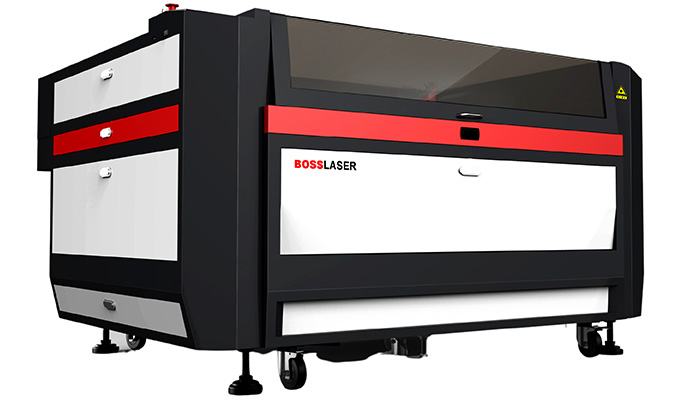
LS · HP · EVO series
~10.6 µm (far infrared)
Concept → buyer
Medical/cosmetic CO2
A CO2 laser is a gas laser. Its gain medium is a mixture of carbon dioxide, nitrogen, and helium sealed in a tube; a high-voltage electrical discharge excites the gas, and the light it emits sits in the far infrared at about 10.6 µm. That wavelength is the whole story: organic materials absorb it strongly — wood, acrylic, leather, paper, fabric — so they cut and engrave beautifully. Bare metal reflects it, which is why metal cutting belongs to fiber lasers. CO2 is the most common laser in sign shops, makerspaces, and job shops, and it’s what the Boss LS, HP, and EVO series are built on.
1 · What’s actually inside the tube.
The gain medium is a gas mixture, and each gas has a job. Carbon dioxide is the molecule that actually emits the laser light. Nitrogen absorbs energy from the electrical discharge efficiently and passes it to the CO2 molecules — it’s the middleman that makes the whole thing efficient. Helium conducts heat away and helps the CO2 molecules return to their ground state so they can be excited again.
Run a high-voltage discharge through that mixture and you have a population inversion. Put mirrors at both ends and you have a beam. In a sealed tube, the gas is a consumable — it degrades over time, which is why a CO2 tube has a service life rather than lasting forever.
Glass tube vs. RF metal tube PRO
Two constructions dominate. Glass (DC-excited) tubes are the common, cost-effective choice — good power for the money, replaceable as a unit. RF-excited metal tubes are excited by radio frequency instead of a DC discharge; they switch faster, which suits fine pulsed engraving, and are typically rebuildable rather than replaced. Specific tube types and service lives vary by model — check the machine’s documentation rather than assuming.
2 · 10.6 microns — the number that decides everything.
Depending on the gas mix and optics, a CO2 laser can emit anywhere across roughly 9.4–10.6 µm, but 10.6 µm is the standard industrial line and the figure quoted on nearly every machine.
Here’s why that single number governs the job list: materials don’t care how many watts you have if they don’t absorb your wavelength. Absorption is a property of the material at that specific wavelength. At 10.6 µm:
| Material group | Behavior at 10.6 µm | Result |
|---|---|---|
| Organics — wood, acrylic, paper, leather, fabric, rubber | Absorb strongly, heat almost instantly at the surface | Clean cutting and engraving — the CO2 sweet spot |
| Glass, stone, ceramic | Absorb at the surface but conduct heat poorly and are brittle | Engraving and frosting, not through-cutting |
| Coated / anodized / painted metal | The coating absorbs, not the metal | Marks well — you’re removing or altering the coating |
| Bare metal — aluminum, copper, brass, steel | Reflects most of the beam | Poor fit. High-power CO2 can cut thin sheet, but metal is a fiber job |
Compare that to a fiber laser at ~1.06 µm, where the table roughly inverts: metals absorb well, organics behave badly. Same physics, opposite outcome, purely because of wavelength.
3 · What a CO2 laser is genuinely good at.
Cutting and engraving non-metals, at speed, with edges that usually need no finishing:
- Acrylic — the showcase material. Cast acrylic gives a flame-polished, glass-clear edge straight off the machine.
- Wood, plywood, MDF — signage, inlays, models, packaging prototypes. Expect a caramelized edge, which is often the look people want.
- Paper, card, cork, felt, leather — clean, fast, and detailed; no tooling to change between jobs.
- Rubber and engineering plastics — stamps, gaskets, seals.
- Glass, stone, ceramic, anodized aluminum — surface marking and engraving.
Never laser PVC or vinyl — this one is not negotiable
PVC and vinyl release hydrogen chloride under the beam, which combines with moisture to form hydrochloric acid. It corrodes the machine’s optics, rails, and electronics from the inside, and it is genuinely dangerous to you. There is no safe power setting. If you can’t identify a plastic with certainty, don’t put it in the machine.
4 · Where CO2 stops — and what to use instead.
Being honest about the limits is more useful than a longer list of strengths:
| The limit | Why | What to use |
|---|---|---|
| Bare metal cutting | Metals reflect 10.6 µm; the beam mostly bounces instead of being absorbed | FC Series fiber cutter |
| Permanent metal marking | Same reflectivity problem; marking bare metal needs ~1.06 µm | FM Series fiber marker |
| Heat-sensitive plastics, fine detail | Far infrared is absorbed as heat, so there’s always a heat-affected zone | UV Series — “cold” marking |
| Through-cutting glass | Brittle and thermally shocked; it cracks rather than cutting cleanly | Engrave with CO2; cut by other means |
The exception worth naming: high-power CO2 machines — the HP series — can cut thin sheet metal. The HP ships with a metal-cutting head whose air holes deliver air assist differently, and that head is what adds the capability — not extra wattage. At 155 W it reaches about 18-gauge stainless and 20-gauge mild steel. It’s a real capability, not the machine’s main purpose.
5 · Correcting a common claim: CO2 is not “the highest-power laser.”
You’ll see this asserted online, and it used to be closer to true. The reasoning behind it isn’t silly: a gas medium can absorb a lot of pump energy without damage, whereas a solid-state crystal can crack or melt if you push it too hard — so for a long stretch, gas lasers scaled to higher powers more easily than solid-state ones did.
But fiber lasers changed that. Spreading the gain medium along a long, thin, actively-cooled doped fiber solves the heat problem that limited older solid-state designs, and industrial fiber cutters are now routinely built at power levels at or beyond what CO2 systems reach — with meaningfully better wall-plug efficiency.
The accurate statement is narrower and more useful: CO2 is an efficient, well-proven, cost-effective way to produce high average power at a wavelength that non-metals love. That’s why it still dominates engraving and non-metal cutting — not because it’s the most powerful laser available.
6 · Continuous or pulsed?
Most CO2 cutting runs the beam in continuous wave (CW) mode — steady power, moving steadily along the cut. For engraving, the beam is switched rapidly as the head scans, which behaves more like a pulsed process and gives you control over depth and shading.
Both modes are covered properly in continuous-wave lasers and pulsed lasers.
7 · The Boss CO2 lineup, in one paragraph.
Three series, and the choice is genuinely straightforward. EVO is the entry desktop platform — smaller work area, lower wattage, for shops getting started or doing detailed small-format work. LS is the standard workhorse line, chosen by bed size and wattage for the material you run most. HP is the high-power line, which adds the ability to cut thin sheet metal on top of everything the LS does.
The honest guidance: size by the sheet you actually run, and power by the thickness you actually cut. Buying more wattage than your material needs mostly buys you a bigger electric bill and a bigger chiller.
Not sure whether you need CO2 at all?
The decision is almost always made by material, not budget. If your work is wood, acrylic, leather, paper, or fabric, it’s CO2. If it’s bare metal, it’s fiber. If it’s both, that’s two machines or one HP-class compromise — and it’s worth being deliberate about which. Compare the laser types →
8 · FAQs
Frequently asked
What Is a CO2 Laser?QWhat is a CO2 laser?
A gas laser whose gain medium is a mixture of carbon dioxide, nitrogen, and helium in a sealed tube. An electrical discharge excites the gas, producing far-infrared light at about 10.6 µm — a wavelength organic materials absorb strongly, which is why CO2 dominates non-metal cutting and engraving.
QWhat is the wavelength of a CO2 laser?
About 10.6 µm, in the far infrared. The range across gas mixtures and optics is roughly 9.4–10.6 µm, but 10.6 is the standard industrial line quoted on nearly every machine.
QWhat can a CO2 laser cut?
Acrylic, wood, plywood, MDF, paper and card, leather, cork, rubber, felt, and many fabrics. It engraves glass, stone, ceramic, and coated or anodized metal. It does not cut bare metal well — that’s a fiber laser job, apart from high-power CO2 cutting thin sheet. Never PVC or vinyl.
QWhat’s the difference between a CO2 and a fiber laser?
The gain medium, and therefore the wavelength. CO2 is a gas laser at ~10.6 µm, absorbed by organics. Fiber is solid-state at ~1.06 µm, absorbed by metals. That one difference decides what each machine is for.
QHow long does a CO2 tube last?
A sealed CO2 tube is a consumable — the gas degrades with use, so tubes are rated for a service life rather than lasting indefinitely. Life varies substantially with tube type, duty cycle, and cooling; check the rating for your specific machine.
9 · Related in this series.
Part of Laser Fundamentals:
- How a laser actually works — the physics under this page
- The types of lasers that matter — CO2 in context
- Continuous-wave lasers — the mode most CO2 cutting uses
- Vaporization cutting — how CO2 cuts organics
Keep exploring
One idea leads to the next.
The fundamentals make every later decision easier. Follow the rest of the series, or talk it through with someone who runs these systems.