
All Boss series
Gain medium
Concept → buyer
Cutting mechanisms
Lasers are classified by gain medium — the material that actually produces the light. Four types cover industry: gas lasers (CO2, ~10.6 µm, for non-metals), solid-state lasers (a doped crystal like Nd:YAG, ~1.064 µm, for marking), fiber lasers (a doped optical fiber, ~1.06 µm, for metal cutting and marking), and semiconductor/diode lasers (chip-sized, which mostly pump the other two). Everything else — dye, excimer, metal-vapor, free-electron — is laboratory or specialist equipment. Pick by material, not by type: a wavelength only cuts what absorbs it.
1 · Gas lasers — CO2 is the one you’ll meet.
The gain medium is a gas or gas mixture, excited by an electrical discharge. Helium-neon and argon lasers are common in labs and optics benches, but industrially, gas laser means CO2.
A CO2 laser emits at about 10.6 µm in the far infrared — a wavelength that organic materials absorb strongly. That’s why CO2 dominates cutting and engraving of acrylic, wood, leather, paper, fabric, rubber, and cork, and why it engraves glass and coated metal but doesn’t cut bare metal well.
Boss lines: EVO (entry desktop), LS (standard workhorse), HP (high power, adds thin sheet metal). Full CO2 explainer →
2 · Solid-state lasers — a doped crystal.
The gain medium is a solid crystal or glass “doped” with an active element. The classic is Nd:YAG — neodymium-doped yttrium aluminum garnet — emitting at 1.064 µm. The very first laser, built in 1960, was solid-state: a ruby rod.
Because that near-infrared wavelength is absorbed by metals, solid-state lasers were the original metal-marking and fine-welding tools. The practical limitation is heat: a short, thick crystal rod is difficult to cool, and push it too hard and the crystal itself distorts or fails. That constraint is exactly what the fiber laser solved.
The close cousin, Nd:YVO4 (neodymium-doped yttrium orthovanadate), trades some maximum power for higher gain and better pulsed behavior. The two compared →
3 · Fiber lasers — the same idea, better packaged.
Here’s the thing most listicles get wrong: a fiber laser is a solid-state laser. The difference is the shape of the gain medium. Instead of a stubby crystal rod, the doped material — usually ytterbium — is distributed along a long, thin optical fiber.
That shape change fixes almost everything:
| Because the medium is a long thin fiber… | You get |
|---|---|
| Enormous surface area relative to volume | Heat escapes easily — so it scales to high power without cooking itself |
| The beam is generated inside a waveguide | Excellent, consistent beam quality with no rod to distort |
| Light is guided by the fiber, not steered by mirrors | No mirror alignment to maintain — a real maintenance difference |
| Diodes pump it directly and efficiently | High wall-plug efficiency and long service life |
Output sits at about 1.06 µm, absorbed well by metals. This is why fiber took over industrial metal cutting and marking.
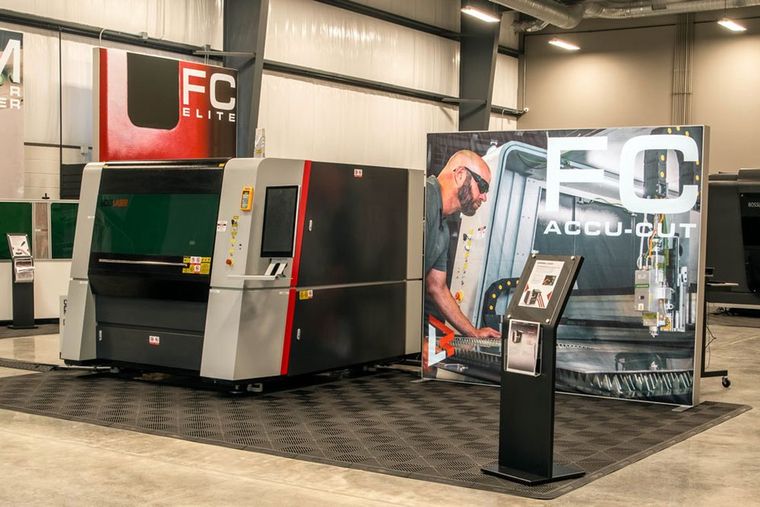
Boss lines: FC Series (metal cutting), FM Series (metal marking and etching).
The fiber-laser tradeoff nobody mentions
The same near-infrared wavelength that metals absorb is also reflected hard by shiny metals — copper and brass especially. Modern machines handle it, but back-reflection is a genuine consideration on highly reflective material, and it’s why reflective-metal cutting gets its own discussion rather than a blanket “yes it can.”
4 · Semiconductor (diode) lasers — the most common laser on earth.
A diode laser is a chip. Current flows across a semiconductor junction and light comes out — no gas, no crystal rod, no mirrors in the traditional sense. They’re tiny, cheap, efficient, and produced in enormous volume.
By unit count this is far and away the most common type of laser in existence: optical drives, barcode scanners, fiber-optic communications, laser pointers, printers. But the industrial role that matters here is different — diodes are the pump source for most fiber and modern solid-state lasers. The laser inside your fiber cutter is being fed by a bank of diodes.
Direct-diode systems are used for some cutting and welding, though beam quality has historically been the limit. More on diode lasers →
5 · And the ones you’ll see on listicles that you’ll never buy.
These are real physics, and a couple are genuinely important instruments. None of them is shop equipment, and they’re listed here only so you can stop wondering when you see them elsewhere:
| Type | What it is | Where you’d find it |
|---|---|---|
| Dye (liquid) laser | Organic dye in solvent as the medium; tunable across a wavelength range | Spectroscopy labs, some dermatology |
| Excimer laser | Reactive gas mixture producing ultraviolet light | Semiconductor lithography, eye surgery |
| Metal-vapor laser | Vaporized metal (copper, helium-cadmium) as the gain medium; needs high temperatures | Research, specialist imaging |
| Free-electron laser | Free electrons through a magnetic array; tunable across a huge range | National research facilities — building-sized |
| Nuclear-pumped laser | Pumped by fission fragments inside a reactor core | Research only |
| Gravitational “laser” | A theoretical device for coherent gravitational radiation | Nowhere — it does not exist |
If you find a “types of lasers” list that includes a hypothetical device, a research-reactor instrument, and a manufacturer’s brand name side by side with CO2 and fiber, the list was built to reach a number, not to help you choose.
6 · Choosing: the material picks the laser.
Forget type names for a second. The only question that produces a right answer is what are you putting in the machine?
| What you’re working with | Laser type | Boss line |
|---|---|---|
| Acrylic, wood, MDF, paper, leather, fabric, rubber, cork | CO2 gas | EVO · LS · HP |
| Engraving glass, stone, ceramic, anodized/coated metal | CO2 gas | LS · EVO |
| Cutting sheet metal — steel, stainless, aluminum, brass, copper | Fiber | FC Series |
| Permanent marking on bare metal — serials, logos, codes | Fiber | FM Series |
| Heat-sensitive plastics, fine “cold” marks, glass marking | UV (frequency-converted solid-state) | UV Series |
| Thin sheet metal and a lot of non-metal work | High-power CO2 | HP Series |
Working in two material families?
That’s the one genuinely hard case, and it’s worth being deliberate rather than hopeful. A high-power CO2 that also handles thin sheet is a real option; so is running two machines. What doesn’t work is expecting one wavelength to be excellent at both — the physics doesn’t bend. See what happens at the cut →
7 · FAQs
Frequently asked
The Types of Lasers That Actually MatterQWhat are the main types of lasers?
By gain medium: gas (CO2 is the industrial one), solid-state (a doped crystal such as Nd:YAG), fiber (a doped optical fiber), and semiconductor/diode. Dye, excimer, metal-vapor, and free-electron lasers exist but are laboratory or specialist instruments.
QWhat type of laser is used for cutting?
CO2 for non-metals — acrylic, wood, leather, paper, fabric. Fiber for metals. The material decides, because a material can only be cut by a wavelength it absorbs.
QIs a fiber laser a solid-state laser?
Yes. The difference is the shape of the gain medium: a long thin doped fiber instead of a short thick crystal rod. That shape sheds heat far better, gives excellent beam quality, and needs no mirror alignment — which is why fiber displaced rod lasers for most industrial metal work.
QWhat is the most common laser?
The semiconductor diode, by an enormous margin — it’s in optical drives, scanners, communications, and pointers, and it pumps most fiber and solid-state industrial lasers. For cutting and engraving specifically, CO2 and fiber dominate.
8 · Related in this series.
Part of Laser Fundamentals:
- How a laser actually works — why the gain medium matters
- What is a CO2 laser? — the gas laser in depth
- Semiconductor & diode lasers — the pump behind the others
- Nd:YAG vs. Nd:YVO4 — inside the solid-state family
- Beam quality and M² — why fiber’s beam is so good
Keep exploring
One idea leads to the next.
The fundamentals make every later decision easier. Follow the rest of the series, or talk it through with someone who runs these systems.