
Boss Laser · Learn
Laser Fundamentals
What a laser actually is, how the beam gets made, the types you’ll meet on a shop floor, and what the numbers on a datasheet really mean. Start here and everything else in the library reads easier.
Every laser — a $200 pointer or a 6 kW metal cutter — is the same three parts doing the same job: something that supplies energy, something that turns it into light, and a pair of mirrors that build that light into a beam. Change the middle part and you change everything the machine can do. That one idea explains why a CO2 laser engraves wood but bounces off copper, and why a fiber laser does the opposite.
In this guide
Nine ways in
Read them in order for a full grounding, or jump to the one you need. Every page stands on its own and links to where the idea gets used.
How a Laser Actually Works
Start here Stimulated emission, population inversion, and the resonator — the whole idea in plain language.What Is a CO2 Laser?
Type · CO₂ The gas laser behind most engraving and non-metal cutting — and why 10.6 µm is the number that matters.The Types of Lasers That Matter
Overview Gas, solid-state, fiber, diode — sorted by what they’re actually used for, not by lab curiosity.Continuous-Wave (CW) Lasers
Beam mode A beam that never switches off — the mode most cutting runs in, and where it falls short.Pulsed Lasers
Beam mode Why chopping the beam into pulses multiplies peak power — and makes marking and fine work possible.Semiconductor & Diode Lasers
Source The chip-sized laser that pumps nearly every fiber machine on the floor.Nd:YAG vs. Nd:YVO4
Source · Marking Two crystals, one wavelength, different jobs — the classic marking-laser comparison.Beam Quality and M²
Spec The spec that decides how small your beam will focus — and therefore how fine it can cut.The Parameters You Actually Set
Operator Power, speed, frequency, focus, passes — what each one does and which to change first.Boss Laser · Learn
Fundamentals down — now see it cut.
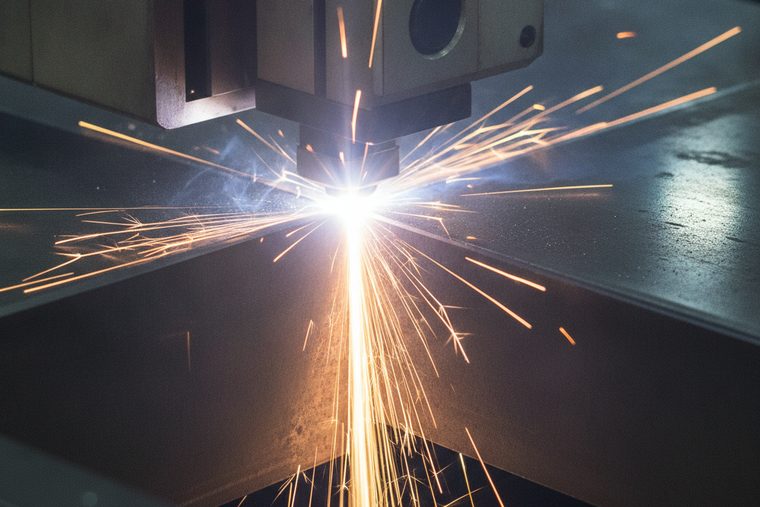
Once you know how the beam is made and what the specs mean, the next question is what happens where that beam meets material. That’s three distinct physical processes, and they decide your edge quality.