
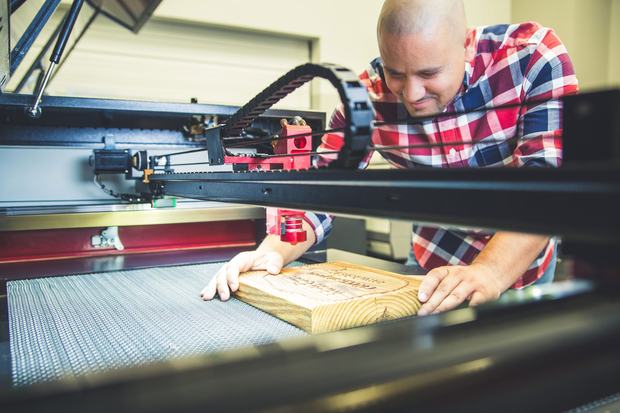
Thin stock, foils, organics
Vaporization / sublimation cutting
Concept → operator
Melt-and-blow metal cutting
In vaporization cutting, the beam heats the material past its boiling point so fast that it leaves the cut as vapor — skipping most of the molten stage that other cuts rely on. Because there’s little or no melt, the edges come out sharp and clean with a small heat-affected zone. The trade-off is that boiling material outright takes very high power density at the focus, so vaporization is at its best on thin materials that char or burn rather than melt well — paper, wood, many plastics, thin foils. It is not how thick metal gets cut: that’s melt-and-blow, where high-pressure assist gas ejects molten metal from the kerf.
1 · What vaporization cutting actually is.
Every laser cut removes material in one of three ways, shown above. Vaporization is the most direct: the focused beam dumps energy into the surface faster than heat can conduct away, the temperature races past the material’s boiling point, and the material leaves as gas. There’s barely a molten in-between stage — the solid goes more or less straight to vapor. That’s the whole trick, and it’s where the clean edge comes from.
Contrast that with the other two mechanisms. In melt-and-blow (also called fusion cutting), the beam melts the material and an assist-gas jet physically blows the melt out of the cut — that’s how a fiber laser cuts sheet metal. In controlled fracture, the beam heats a line on a brittle material like glass and thermal stress cracks it along that path. Vaporization is the one where the material simply leaves.
The one-line mental model
Melt-and-blow pushes material out of the cut; vaporization evaporates it out. No melt pool to eject means no melt bulge on the edge — but it costs a lot more energy per unit removed.
2 · Why it takes so much power.
Boiling a solid straight to vapor skips no steps and stores a lot of energy in the vapor, so vaporization demands a high power density — a lot of watts concentrated into a tiny focused spot — delivered fast enough that the surface reaches boiling before the heat spreads sideways. The exact power-density threshold varies widely by material and pulse regime, which is why there’s no single blanket figure — the original source printed a fixed low number that doesn’t hold up across materials, so we’ve left it out.
Two practical consequences fall out of that power demand:
- Thin beats thick. Past a certain thickness the beam can’t drive the whole depth to boiling fast enough, and the cut stalls or turns into a melt. Vaporization is a thin-material mechanism.
- Pulsed lasers help. Short, high-peak-power pulses can hit vaporization power density without cooking the surrounding material, which is why pulsed sources show up in fine vaporization and micromachining work. More on pulsed vs continuous-wave lasers
3 · What vaporization does well.
When the material suits it, vaporization is hard to beat on edge quality:
- Sharp, clean edges. No melt pool means no re-solidified bulge or dross on the edge — often no secondary finishing needed.
- Small heat-affected zone. Energy goes into removing material, not spreading through it, so the surrounding area stays comparatively cool and undistorted.
- Fine, complex detail. A small focused spot vaporizing a thin sheet can hold intricate shapes, stencils, and tight internal features at speed.
- It’s just a file change. Like all laser cutting, changing the part means changing the design file, not retooling — small runs of intricate parts stay economical.
4 · Where it struggles.
| Limitation | Why it happens | What to do about it |
|---|---|---|
| Thickness ceiling | The power density needed to boil the full depth fast enough runs out as material gets thicker. | Use vaporization for thin stock; switch to melt-and-blow (fiber) for thick metal. |
| Fumes & vapor | The removed material becomes airborne gas — and on some plastics that gas is toxic or corrosive. | Always run extraction; filter before exhaust; never cut unknown or PVC-type plastics. See materials to avoid |
| Energy cost per cut | Boiling material outright is energy-hungry compared with melting and blowing it. | On materials that melt-and-blow cleanly (most metals), that mechanism is more efficient. |
Correcting a common claim: you don’t need a vacuum chamber
You’ll see it said that vaporization cutting “must be done in a vacuum.” For everyday cutting of paper, wood, acrylic, and thin plastics, that’s not true — it happens in open air with good exhaust, like any other laser job. A vacuum only enters the picture in specialized thin-film micromachining and lab-scale ablation, which is a different process from cutting parts on a shop laser. Don’t let the vacuum myth scare you off the mechanism.
5 · Materials that vaporize well.
| Material | How it behaves | Watch for |
|---|---|---|
| Paper & cardstock | Thin by nature, cuts fast and clean. | Edges char slightly — the paper burns a little at the cut line. |
| Wood & MDF | Organics vaporize and burn; good detail on thin stock. | Darkened edges; run enough air/exhaust to clear the plume. |
| Many plastics & rubber | Thin sheets cut cleanly. | Some plastics emit toxic fumes — verify the material first; never cut PVC/vinyl. |
| Thin metal foils | Good thermal conductivity carries heat away fast, giving accurate, sharp cuts. | Only thin gauges; thicker metal moves to melt-and-blow. |
6 · Vaporization vs. melt-and-blow — the distinction that matters.
This is the single most useful thing to get straight, because it decides which machine you actually need:
| Vaporization | Melt-and-blow (fusion) | |
|---|---|---|
| How material leaves | Boils to vapor | Melts, then assist gas ejects it |
| Assist gas role | Mostly clears fume/smoke | High-pressure gas is part of the cut |
| Best materials | Thin organics, foils | Sheet metal, thicker plate |
| Typical laser | CO2 (organics); pulsed for fine work | Fiber (metal) |
Cutting metal? That’s melt-and-blow, not vaporization.
If your job is sheet steel, aluminum, or stainless, the mechanism you want is melt-and-blow — a fiber laser with high-pressure assist gas. It’s more efficient on metal and handles real thickness. Read that process in the sibling article: Oxidation & melt cutting →
7 · Which Boss laser fits.
Match the laser to the material, not to the mechanism name:
- Paper, wood, acrylic, leather, most organics → a CO2 laser: the Boss EVO (entry desktop), LS (standard, sized by bed and power), or HP (high-power — and the one CO2 line that also cuts thin sheet metal).
- Thin metal foils and metal parts → a fiber laser, the Boss FC series — though most metal work is melt-and-blow, not pure vaporization. Match power to your thickest material: a 2 kW fiber cutter handles roughly 8 mm stainless or 6 mm aluminum, and 3 kW reaches about 10 mm stainless.†
† Typical fiber cut capacity from published industry references; actual thickness depends on power, assist gas, and finish requirements. Boss matches the FC model to your material and thickness.
Which machine does this?
For organics — paper, wood, acrylic — that’s a CO2 laser. For thin metal, a fiber cutter. Match the machine to the material, not to the mechanism name.
Frequently asked
Vaporization cuttingQWhat is laser vaporization cutting?
It’s the cutting mechanism where the beam heats material past its boiling point so it leaves the cut as vapor, with almost no molten phase. Little melt means sharp, clean edges and a small heat-affected zone. It suits thin materials that char or burn rather than melt well, and it needs very high power density at the focus.
QHow is it different from how a fiber laser cuts metal?
A fiber laser cutting metal uses melt-and-blow: it melts the metal and a high-pressure assist gas ejects the molten metal out of the kerf. Vaporization instead boils material straight to gas and needs almost no assist pressure to clear it. Thick metal is cut by melt-and-blow, not vaporization.
QDoes vaporization cutting really need a vacuum chamber?
No. Cutting paper, wood, and thin plastics happens in open air with exhaust, not in a vacuum. Vacuum only applies to specialized micromachining and thin-film work — a different, lab-scale process from shop cutting.
QWhat materials work best?
Thin materials without a useful molten stage: paper and cardstock, wood and MDF, many plastics and rubber, and thin metal foils. Paper and wood char slightly at the edge, and some plastics release toxic fumes — verify the material and always run extraction.
QWhich Boss laser should I use?
For organics and non-metals, a CO2 laser like the Boss LS or EVO series. For thin metal, a fiber laser like the Boss FC series — though most metal cutting is melt-and-blow. Match the machine to your material and thickness.
Related in this series.
Part of How Laser Cutting Works. The three mechanisms and the process around them:
- Oxidation & melt cutting — how metal actually gets cut
- Controlled-fracture cutting — cutting brittle materials by cracking them
- Laser ablation — vaporization’s close cousin, used for micromachining and surface removal
- Laser cutting, start to finish — the full process this fits into
Keep learning
Understand the machine before you buy it.
Vaporization is one of three ways a laser cuts. Explore the rest of the Learn library, or tell a specialist what you cut and we’ll point you to the right system.