
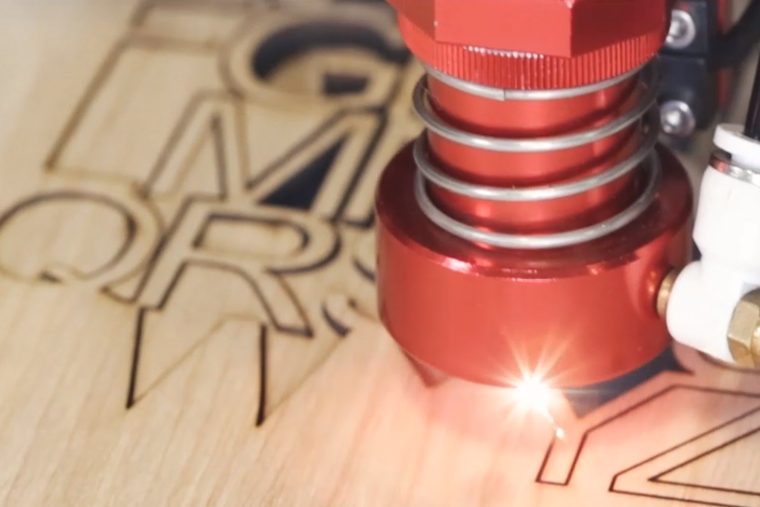
Most cutting — CO2 & fiber
Continuous, steady power
Concept → operator
Pulse generation
A continuous-wave (CW) laser emits a steady, uninterrupted beam at essentially constant power for as long as it’s running. Nothing is being switched or stored — the pump runs, the population inversion holds, and light comes out. This is the mode most laser cutting uses, because cutting a continuous contour wants continuous heat in the kerf. Its strength is simplicity and steady throughput; its limit is heat — the beam never stops depositing energy, so heat spreads outward from the cut and the heat-affected zone grows. When that matters, you pulse instead.
1 · What “continuous” actually means.
In CW operation the laser reaches a steady state and stays there. The pump keeps feeding energy in, the population inversion is continuously replenished, and photons leave the output coupler at a constant rate. Power out is essentially flat over time — the flat red line in the diagram above.
Compare that to a pulsed laser, which deliberately stores energy and dumps it in bursts. The difference isn’t how much total energy arrives; it’s how it’s distributed in time. Two lasers rated at the same average power behave completely differently depending on whether that power arrives smoothly or in spikes.
2 · Why cutting runs CW.
Cutting is a continuous process. The head follows a path, and the material at the cut front needs to stay hot enough to keep melting or vaporizing as it moves. A steady beam delivers exactly that.
| What CW gives you | Why it matters at the cut |
|---|---|
| Steady heat at the cut front | The kerf stays molten/vaporizing without re-heating from cold on every pulse — smoother edges, faster travel |
| Predictable, simple control | Two main dials — power and speed — instead of a pulse-parameter matrix |
| High average power, sustained | Thicker material needs sustained energy delivery, not brief spikes |
| Consistent results over long runs | No pulse-to-pulse variation to drift over a production shift |
This holds for both wavelengths: CO2 machines (LS · HP · EVO) cutting acrylic and wood, and fiber cutters (FC Series) cutting sheet metal, both run their cutting in CW.
3 · Where “always on” turns into a problem.
Continuous energy means continuous heat, and heat doesn’t only go where you aimed it — it conducts sideways into the material around the cut. That region is the heat-affected zone (HAZ), and with a CW beam it’s inherently larger than with a pulsed one.
Where that shows up:
- Thin or delicate material — heat has nowhere to go, so it warps, discolors, or melts back into the kerf.
- Heat-sensitive plastics — melting, deformation, and scorching around the cut line.
- Very fine detail — small features and tight geometry blur when the affected zone approaches feature size.
- Marking bare metal — you generally want a controlled surface reaction, not sustained bulk heating.
The practical operator version
If your edges look scorched, melted, or rounded and the geometry is right, you have a heat problem, not an aim problem. The first moves are more speed, less power, or fewer/faster passes — get the same cut done with less total energy dwelling in one place. Only then start reaching for other parameters. Which dial to turn first →
4 · CW vs pulsed, side by side.
| Continuous wave | Pulsed | |
|---|---|---|
| Power delivery | Steady and uninterrupted | Short bursts with gaps between |
| Peak power | Equal to average power | Far higher than average power |
| Heat-affected zone | Larger — heat keeps arriving | Smaller — material cools between pulses |
| Best at | Cutting contours, welding, sustained throughput | Marking, engraving detail, heat-sensitive material, ablation |
| Control | Simple — power and speed | More parameters — frequency, pulse duration, peak power |
Neither is superior. They’re different tools for different jobs, and most industrial machines can do both — pulsed lasers, in full →
5 · Engraving is the interesting middle case.
Engraving on a CO2 machine looks like a CW job but isn’t quite. The head scans back and forth like a printer, and the beam is switched on and off very rapidly to place material removal only where the image calls for it. Functionally that behaves like a pulsed process, and it’s why engraving exposes controls — frequency among them — that straight contour cutting doesn’t make you think about.
That’s also why the same machine can produce a clean cut and a muddy engraving in the same session: the two jobs are being run in genuinely different regimes.
6 · What runs CW.
Most industrial gain media can run continuously, given enough cooling:
| Type | CW behavior | Boss line |
|---|---|---|
| CO2 gas | Runs CW readily; the standard mode for non-metal cutting | LS · HP · EVO |
| Fiber | Runs CW at high power with excellent efficiency — the metal-cutting standard | FC Series |
| Diode | Natively continuous; used directly and as the pump for fiber lasers | (inside FC/FM) |
| Solid-state rod | Can run CW, but cooling the rod is the limiting factor | — |
Marking lasers are the notable exception — the FM Series is fundamentally a pulsed tool, because marking wants high peak power and a small heat-affected zone.
Safety note that’s specific to CW
A continuous beam delivers energy for as long as it’s on — there’s no gap that limits an accidental exposure. Combined with invisible near-infrared wavelengths on fiber machines, that’s exactly why enclosures and interlocks exist and why they never get bypassed “just for this one job.”
7 · FAQs
Frequently asked
Continuous-Wave (CW) LasersQWhat is a continuous-wave laser?
One that emits a steady, uninterrupted beam at essentially constant power while running, rather than firing in bursts. It’s the mode most laser cutting uses.
QWhat’s the difference between CW and pulsed?
How the energy is distributed in time. CW delivers steady power continuously; pulsed stores energy and releases it in bursts whose peak power far exceeds the average, with cooling gaps between. CW suits cutting and welding; pulsed suits marking, fine detail, and heat-sensitive work.
QIs laser cutting continuous wave?
Usually. A continuous contour wants continuous heat. Engraving is the exception — the beam is switched rapidly as the head scans, which behaves more like a pulsed process.
QWhat are the disadvantages of CW?
Heat. The beam never stops depositing energy, so it spreads outward from the cut and the heat-affected zone is larger — a problem on thin, delicate, or heat-sensitive material and on very fine detail. CW also can’t reach the very high peak powers pulsing achieves.
8 · Related in this series.
Part of Laser Fundamentals:
- Pulsed lasers — the other half of this comparison
- How a laser actually works — what’s being held steady
- The parameters you actually set — power, speed, frequency
- Melt-and-blow cutting — CW at work on metal
Keep exploring
One idea leads to the next.
The fundamentals make every later decision easier. Follow the rest of the series, or talk it through with someone who runs these systems.