
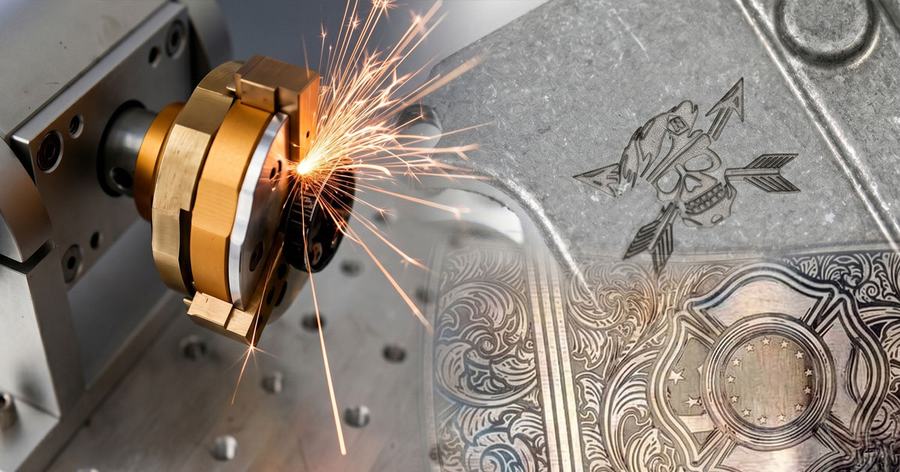
FM · UV series; engraving
Bursts, high peak power
Concept → operator
Continuous cutting
A pulsed laser emits energy in short bursts instead of continuously. Because energy is accumulated between pulses and released all at once, the peak power of a pulse is enormously higher than the laser’s average power. Two things follow, and both are the reason pulsing exists: that peak reaches material-removal thresholds a steady beam of the same average power never touches, and the gap between pulses lets the material cool, so the heat-affected zone stays small. That’s why marking, fine engraving, and ablation are pulsed jobs — and why the FM and UV series are pulsed tools.
1 · Peak power vs. average power — the whole idea.
This distinction confuses people, and it’s worth being precise about because it’s the entire justification for pulsing.
Average power is the energy delivered over time — the number on the spec sheet. Peak power is how much power is flowing during a pulse. Squeeze a fixed amount of energy into a shorter and shorter window and peak power climbs, even though average power hasn’t changed at all.
Put concretely: take a modest pulse of energy and release it over a few nanoseconds, and the instantaneous power during that flash is orders of magnitude above the machine’s average rating. A continuous laser of the same average power simply never reaches that instantaneous intensity — it delivers the same total energy as a gentle, unending trickle.
Material removal has thresholds. Below a certain power density, you heat a material; above it, you remove it. Pulsing is how a modest average-power machine gets above that threshold.
2 · Why the gaps matter as much as the pulses.
The off-time is not wasted time. During the gap, heat that was deposited by the pulse conducts away and the surrounding material returns toward ambient temperature. The next pulse then starts from something close to cold.
The consequence is a small heat-affected zone. That’s what allows:
- Marking without warping the part — the surface reacts, the bulk stays cool and dimensionally stable.
- Fine detail — features stay crisp because the affected zone is smaller than the features.
- Heat-sensitive materials — plastics and thin stock that a continuous beam would melt or deform.
“Cold” processing PRO
Push pulse duration short enough — into the picosecond and femtosecond range — and material leaves the surface faster than heat can conduct into what remains. This is cold ablation: removal with almost no thermal damage. Ultrashort-pulse systems are specialist equipment, but the principle is the same one operating at every pulse duration, just taken to its limit. How ablation works →
3 · How pulses get made.
| Method | What happens | Typical use |
|---|---|---|
| Gain switching | The pump itself is switched on and off, so the laser only lases when fed | Simple, moderate peak power; common in diode-driven systems |
| Q-switching | A switch inside the resonator spoils lasing while energy accumulates in the medium, then opens — dumping it all in one short, intense pulse | The standard for marking lasers — high peak power, nanosecond-scale pulses |
| Mode locking | Resonator modes are locked in phase, producing an extremely rapid train of ultrashort pulses | Picosecond/femtosecond work — micromachining, research |
| Modulated CW | A continuous beam is switched rapidly by the controller | CO2 engraving — behaves pulse-like without being a true pulsed laser |
Q-switching, in plain terms
Picture holding a door shut while pressure builds behind it, then opening it all at once. The “Q” is the resonator’s quality factor — how well it sustains lasing. Spoil it deliberately and the gain medium keeps absorbing pump energy without releasing light, because the cavity won’t let a beam build. Restore it suddenly and everything stored comes out in a single very short, very intense pulse.
That’s how a fiber marker with a modest average-power rating produces peak powers high enough to permanently alter steel.
4 · The parameters you actually control.
| Parameter | What it is | Turn it up and… |
|---|---|---|
| Pulse frequency (repetition rate) | Pulses per second, in kHz | Pulses overlap more — smoother, shallower, more thermal; each pulse carries less energy |
| Pulse duration (width) | How long each pulse lasts — ns, ps, fs | Shorter means higher peak power and less heat spread |
| Pulse energy | Energy in a single pulse | More removal per pulse — deeper, more aggressive |
| Average power | Energy over time — pulse energy × frequency | Overall throughput; the spec-sheet number |
| Scan speed | How fast the beam moves across the surface | Less overlap between adjacent pulses — lighter mark, faster job |
These interact, which is what makes marking feel fiddly at first. Raise frequency at fixed average power and each pulse gets weaker — the mark goes from engraved to annealed. That’s not a fault; it’s the control you’re being given. The full parameter walkthrough →
5 · What pulsed lasers are used for.
| Job | Why pulsed | Boss line |
|---|---|---|
| Metal marking — serials, logos, 2D codes, traceability | High peak power alters the surface; gaps keep the part cool and undistorted | FM Series |
| Cold marking — heat-sensitive plastics, glass, fine detail | Short pulses at short wavelength remove material with minimal thermal damage | UV Series |
| Laser cleaning — rust, paint, coating removal | Pulses lift the coating without heating the substrate underneath | FC Lumin X handheld cleaner |
| Engraving detail on CO2 machines | Rapid beam switching controls depth and shading pixel by pixel | LS · EVO |
6 · The honest limitations.
- Not the tool for thick continuous cutting. Cutting wants sustained heat at the cut front; a pulsed beam keeps letting it cool. That’s a CW job.
- More parameters to get wrong. Frequency, duration, energy, and speed all interact — there’s a real learning curve, and it’s why test grids on scrap are standard practice.
- Peak power can damage what you’re processing. The same intensity that removes a layer can crack, pit, or discolor if the settings are wrong for the material.
- System cost and complexity. Q-switches and ultrashort-pulse sources add hardware that a plain CW machine doesn’t need.
Pulsed lasers are a distinct safety case
Do not reason about pulsed exposure from average power. A pulse’s peak intensity can cause immediate, permanent injury even when the average rating looks modest — and near-infrared marking wavelengths are invisible, so there’s no blink reflex to help. Enclosure and interlocks are the control, and appropriate eyewear must be matched to the specific wavelength, never assumed.
7 · FAQs
Frequently asked
Pulsed LasersQWhat is a pulsed laser?
One that emits energy in short bursts rather than continuously. Energy is stored between pulses and released at once, so peak power during a pulse is far above the laser’s average power, while the material cools in the gaps.
QWhy pulse instead of running continuous?
High peak power crosses material-removal thresholds a steady beam of the same average power can’t reach, and the cooling gaps keep the heat-affected zone small. That combination is what makes marking, fine detail, and heat-sensitive work possible.
QWhat is Q-switching?
A switch inside the resonator temporarily prevents lasing so energy accumulates in the gain medium; when it opens, everything stored dumps out as one short, intense pulse. It’s the standard method in marking lasers.
QCan a pulsed laser mark metal?
Marking is essentially always pulsed. A permanent mark needs enough peak power to alter or remove a thin surface layer without heating the part underneath — exactly what pulsing provides. Fiber and UV markers both work this way.
QDoes every laser have a pulsed mode?
No. Some are built specifically for continuous operation and some specifically for pulsed. Many industrial machines can do both, and CO2 engraving achieves pulse-like behavior by rapidly switching a continuous beam rather than being a true pulsed laser.
8 · Related in this series.
Part of Laser Fundamentals:
- Continuous-wave lasers — the other half of this comparison
- Nd:YAG vs. Nd:YVO4 — two crystals, different pulsed behavior
- The parameters you actually set — frequency, duration, power
- Laser ablation — what pulses do at the surface
Keep exploring
One idea leads to the next.
The fundamentals make every later decision easier. Follow the rest of the series, or talk it through with someone who runs these systems.