
CO2 — EVO · LS · HP
Laser behaviour
Buyer → operator
The refuse list
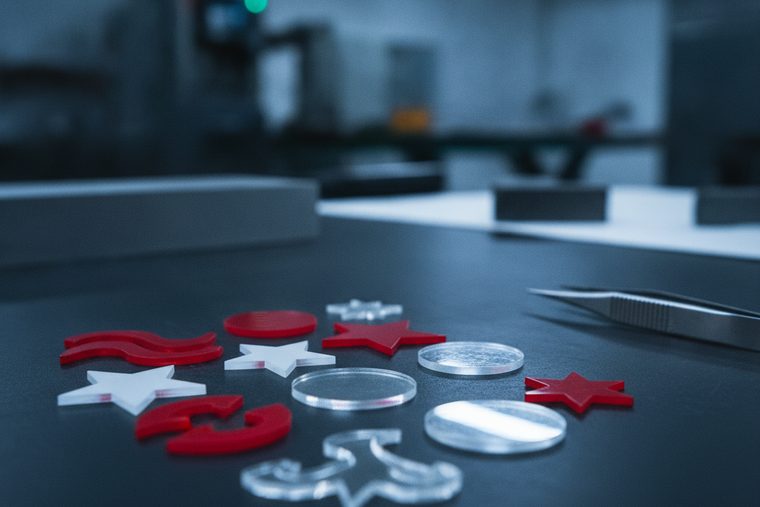
Cast acrylic is the best plastic for laser cutting and nothing else is close for appearance — clean vaporization, a flame-polished edge, bright frosted engraving. Delrin (acetal) is the pick when the part has to work mechanically rather than look good. After that it drops off quickly: polypropylene, polyethylene and PETG melt rather than cutting crisply, and polycarbonate chars and yellows. Three are outright refusals — PVC/vinyl, PTFE and ABS — and they’re in the table below rather than on a separate page, because that’s where you’ll actually be looking when you’re choosing.
1 · The ranking.
| Plastic | How it behaves | Verdict |
|---|---|---|
| Acrylic (PMMA) — cast | Vaporizes cleanly; glossy polished edge; engraves bright white | Best in class. The display and signage standard |
| Acrylic (PMMA) — extruded | Cuts well; duller edge; engraves nearly clear | Good for cut-only parts; wrong for engraving |
| Delrin / acetal (POM) | Crisp cuts, matte edge, excellent dimensional stability | Best for mechanical parts. Extraction essential — formaldehyde |
| Polyimide (Kapton) | Cuts cleanly in thin film; very heat tolerant | Good in its niche — electronics, masking |
| Mylar / PET film | Cuts well in thin gauges; melts at edges as thickness rises | Good thin; poor thick |
| PETG | Cuts, but tends to melt at the edge; grade-dependent | Workable where the edge isn’t the feature |
| Polypropylene (PP) | Melts rather than vaporizing; edges slump and re-weld | Marginal. Thin stock, patience, melted edge |
| Polyethylene (HDPE/LDPE) | Melts readily; sustains flame | Poor. Fire risk; rarely worth it |
| Polycarbonate (PC) | Absorbs strongly at the surface; yellows, chars, burns | Poor. Thin film at best — why → |
| ABS | Releases hydrogen cyanide and styrene; melts and chars | ✗ Do not cut. Fails on safety and quality |
| PTFE (Teflon) | Releases hydrogen fluoride when overheated | ✗ Do not cut. Severely corrosive and toxic |
| PVC / vinyl | Releases hydrogen chloride → hydrochloric acid | ✗ Never. Destroys the machine and harms you |
2 · Why some cut clean and others melt.
The dividing line is what the plastic does with absorbed energy. Materials that go more or less straight from solid to vapour — acrylic being the exemplar — clear the kerf as gas and leave a smooth edge, because there’s little molten material left behind to re-solidify.
Materials that soften and flow first — polypropylene, polyethylene, PETG — produce a melt pool. The beam moves on, the melt slumps back toward the kerf, and you get a rounded, sometimes re-welded edge no matter how carefully you set power and speed. That’s a material property, not a tuning failure.
Practical consequence: if a plastic melts, more speed and less power is usually the better direction — less total heat, less time to flow. It improves things; it doesn’t transform them.
3 · Choosing by what the part has to do.
| The part needs to… | Use |
|---|---|
| Look good — display, signage, retail, awards | Cast acrylic |
| Be engraved with visible contrast | Cast acrylic (extruded won’t show) |
| Work mechanically — gears, bushings, fixtures | Delrin / acetal |
| Be cheap and cut-only, edge not visible | Extruded acrylic |
| Survive impact | Polycarbonate — but cut it another way |
| Be a thin flexible film | Kapton or Mylar — see the thin stock page |
| Be food-safe, chemical-resistant, or certified | Check the certification path first — the laser is rarely the constraint |
The refusals are not a spectrum
Most of this page is trade-offs — a slightly worse edge, a bit more smoke, a slower cut. The last three rows aren’t. PVC, PTFE and ABS aren’t “lower quality”; they release things that damage the machine and the operator, and no setting changes that. If you take one thing from this page, take the difference between this cuts badly and this must not be cut. The full never list, and how to identify unknowns →
4 · FAQs
Frequently asked
Which Plastics Cut WellQWhat’s the best plastic for laser cutting?
Cast acrylic — clean vaporization, polished edge, bright frosted engraving. Delrin where mechanical precision matters more than looks.
QWhich plastics should never be cut?
PVC/vinyl (hydrogen chloride → hydrochloric acid), PTFE (hydrogen fluoride), and ABS (hydrogen cyanide, styrene). No power setting makes any of them acceptable.
QWhy do some plastics melt?
They soften and flow before they vaporize, so the melt slumps back into the kerf behind the beam. Acrylic goes closer to straight from solid to vapour, which is why its edges come out clean.
QCan you cut PETG?
Yes, but it melts at the edge and results vary by grade. Fine for functional parts; use acrylic where appearance matters.
5 · Related in this series.
Part of Materials & Safety:
- Acrylic — the top of this list, in depth
- Delrin / acetal — the mechanical choice
- What must never go in a laser
Keep exploring
One idea leads to the next.
Knowing how a material behaves under the beam is most of the job. Follow the rest of the series, or talk it through with someone who runs these systems.