
CO2 — EVO · LS
Four thin materials
Operator
Fire — genuinely
Thin stock — paper and card, Kapton (polyimide) film, Mylar (PET) film, and cork — cuts fast, holds fine detail, and is cheap enough to iterate on. Two things dominate the practice, and neither is about settings. Fire: this stock is thin, dry and combustible, so air assist and extraction run always and the machine is never left unattended. Holding it flat: the same air assist and extraction that keep you safe will lift lightweight material out of focus and into the beam path, so a honeycomb bed with magnets, low-tack tape outside the cut area, or a vacuum bed is part of the job rather than an optional extra.
This is where laser fires start
Thin combustible stock is the most common origin of a laser fire, for an unglamorous reason: it ignites easily, it’s often run fast in long unattended batches, and a lifted corner can flap directly into the beam. Air assist running. Extraction running. Bed clear of offcuts. Never leave it unattended — not for a coffee, not for one phone call. A small flame that follows the beam and self-extinguishes is normal; a flame that stays put after the head has moved on is a fire.
1 · Paper and cardstock.
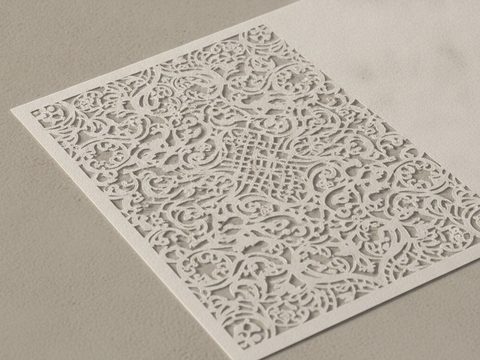
Among the fastest, most detailed work a CO2 laser does — intricate cuts that would be impossible by hand, at speed, with no tooling. Standard for invitations and stationery, packaging prototypes and dielines, stencils and masks, model making and architectural models, and decorative work.
- Very low power, high speed. Paper needs far less energy than people expect; excess power scorches the cut line brown.
- Edge colour is a choice. A faint tan edge is normal; a dark burnt edge means too much energy.
- Coated and laminated stock varies wildly. A foil or plastic laminate can behave completely differently — and if the coating is unidentified, treat it as unknown plastic.
- Weight matters more than type. Heavy card is more forgiving than tissue-weight stock, which lifts at the slightest airflow.
2 · Kapton (polyimide film).
Polyimide is the high-performance film of this group: it tolerates heat far better than most plastics, which is exactly why it’s used in electronics. Laser work on it is typically solder-paste stencils, masking for selective processes, and flexible-circuit applications.
It cuts cleanly in thin gauges and holds fine features well — the stencil apertures it’s usually asked for are small, and it manages them. Treat it as thin film for handling: flat, held down, watched.
3 · Mylar (PET film).
Mylar cuts well in thin gauges and is common for stencils, masks, templates, and packaging prototypes. The caveat is thickness: as it gets heavier, PET’s tendency to melt at the edge asserts itself and the cut goes from crisp to rounded and slightly tacky.
Be careful with the word “Mylar” — it’s used loosely for a range of metallized and laminated films, and a metallized layer changes both the cut and the reflectivity. If the film is silvered and unlabelled, find out what it is.
4 · Cork.
Cork cuts and engraves nicely, and it’s a satisfying material — coasters, gaskets and seals, pin boards, backing sheets, and decorative panels.
- Expect a darkened edge. That’s inherent to cutting an organic material, not a fault to tune out.
- Natural cork and composite cork are different materials. Composite is granules plus a binder, and the binder determines the smoke. If you don’t know what the binder is, you don’t know what you’re cutting.
- Thickness drives everything. Thin sheet cuts easily; thicker cork needs more power and produces noticeably more smoke.
- It’s dusty. Cork debris accumulates in the machine and is itself combustible — clean the bed.
5 · Holding thin material flat.
| Method | Notes |
|---|---|
| Honeycomb bed + magnets | The standard. Magnets at the edges, outside the cut path — a magnet in the beam path is a bad day |
| Low-tack masking tape | Tape the perimeter outside the cut area. Check the tape isn’t vinyl-based |
| Vacuum bed | The proper solution for volume thin-stock work — holds the whole sheet flat and dead still |
| Weighted frame | Workable, but only with something non-combustible that can’t shift into the path |
Two reasons this matters beyond tidiness: lifted material goes out of focus, so cut quality falls off across the sheet, and a lifted corner can flap into the beam, which is how a manageable job becomes a fire.
6 · FAQs
Frequently asked
Kapton, Mylar, Cork & PaperQCan you laser cut paper?
Yes, superbly — fast and highly detailed, standard for invitations, packaging prototypes, stencils and models. Fire is the dominant risk: air assist and extraction running, machine never unattended.
QHow do I stop thin material lifting?
Honeycomb bed with magnets at the edges outside the cut path, low-tack tape around the perimeter, or a vacuum bed. Never weight it with anything combustible. Lifted material goes out of focus and can flap into the beam.
QIs Kapton cuttable?
Yes — polyimide film cuts cleanly in thin gauges and holds fine features, which is why it’s used for solder stencils and masking in electronics work.
QCan you cut cork?
Yes, for coasters, gaskets, boards and backing. Expect a darkened edge. Natural and composite cork differ, and with composite the binder determines the smoke — check what you have.
7 · Related in this series.
Part of Materials & Safety:
- Which plastics cut well — where Mylar and Kapton rank
- What must never go in a laser — including unknown coatings and tapes
- Acrylic — the other material where fire is the real risk
Keep exploring
One idea leads to the next.
Knowing how a material behaves under the beam is most of the job. Follow the rest of the series, or talk it through with someone who runs these systems.