
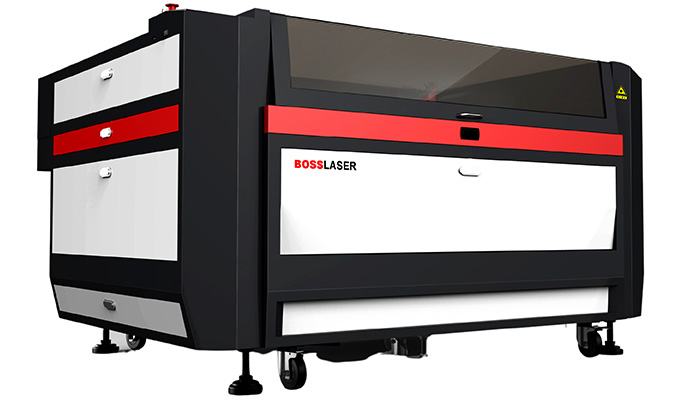
FC vs. LS / HP / EVO
Which machine cuts your metal
Buyer
Per-material thickness
The difference is the gain medium, and therefore the wavelength. A CO2 laser is a gas laser at about 10.6 µm; a fiber laser is solid-state at about 1.06 µm. Bare metal reflects most of 10.6 µm and absorbs far more at 1.06 µm — so fiber cuts metal and CO2 largely bounces off it, no matter how many watts you throw at it. Organics do the reverse, which is why CO2 owns wood, acrylic, leather, and fabric. Fiber also runs at meaningfully higher electrical efficiency, needs no mirror alignment, and has no laser gas to replace — but it costs more up front and is the wrong tool for most non-metals. Pick by material first; everything else is secondary.
1 · The one difference everything else comes from.
Absorption is a property of a material at a specific wavelength. It isn’t a quality ranking, and it isn’t something more power overcomes. A polished steel sheet under a 10.6 µm beam throws most of that energy straight back; the same sheet under a 1.06 µm beam takes a great deal of it in.
That’s the whole fork. Everything below is downstream of it.
| CO2 | Fiber | |
|---|---|---|
| Gain medium | CO2/N2/He gas in a sealed tube | Ytterbium-doped optical fiber |
| Wavelength | ~10.6 µm (far infrared) | ~1.06 µm (near infrared) |
| Absorbed well by | Organics — wood, acrylic, leather, paper, fabric | Metals — steel, stainless, aluminum, brass, copper |
| Cuts metal? | Thin sheet only, and only on the HP — about 18-gauge stainless / 20-gauge mild steel | Yes — this is its purpose |
| Cuts wood/acrylic? | Yes — excellently | No — poorly absorbed, scorches rather than cuts cleanly |
| Boss line | EVO · LS · HP | FC (cutting) · FM (marking) |
2 · Running cost and efficiency.
Fiber converts a substantially larger share of the electricity it draws into actual laser output. The gap is wide enough to show up on a power bill rather than only on a spec sheet. Exact wall-plug percentages are manufacturer- and configuration-specific — take them from the spec sheet for the two machines you are actually comparing. The direction is not in dispute.
What that means in a shop: for the same work, the fiber machine draws less power and rejects less waste heat, which also shrinks the chiller it needs. Over a year of production those are real line items.
The cost comparison people get backwards
Fiber usually costs more to buy and less to run. CO2 usually costs less to buy and more per hour, plus a tube that is a genuine consumable. Which one wins depends entirely on your duty cycle — a machine running two shifts settles the argument very differently from one running four hours a week. If you’re comparing quotes, compare five-year cost, not sticker price.
3 · Maintenance — the difference nobody quotes you.
This is where the two diverge most in daily life, and the LCG source omitted it entirely:
| CO2 | Fiber | |
|---|---|---|
| Beam delivery | Mirrors steer the beam — alignment must be maintained | Light is guided in the fiber — no alignment |
| Laser source life | Tube is a consumable with a service life | Very long source life; no gas to replace |
| Consumables | Tube, lens, mirrors, laser gas (tube-dependent) | Protective window, nozzles, assist gas |
| Sensitive to | Knocks that shift alignment; dirty mirrors | Contaminated protective window; back-reflection on shiny metal |
Neither is maintenance-free. But “no mirrors to align” is a real, ongoing operational difference, not a brochure line — and it’s a large part of why fiber took over metal fabrication.
4 · Footprint and installation.
Fiber sources are compact and integrate tightly; CO2 systems carry a tube and its supporting cooling hardware, so a comparable machine is generally larger and heavier. That affects floor space, how it gets into your building, and installation cost.
Worth keeping in proportion, though: for a cutting machine, the bed size you need dominates the footprint conversation far more than the laser source does. Dimensions and weight are per-model numbers, so read them off the spec sheet for the machine you are considering — and the ones that usually matter are whether it fits through your door and what the floor will carry.
5 · What each one is genuinely better at.
| If your work is… | Use | Why |
|---|---|---|
| Sheet metal — steel, stainless, aluminum | Fiber (FC) | Absorbed, so it cuts fast and clean |
| Permanent marking on bare metal | Fiber (FM) | Same absorption advantage at marking power |
| Wood, acrylic, MDF, leather, fabric, paper | CO2 (LS · EVO) | Organics absorb 10.6 µm strongly |
| Engraving glass, stone, ceramic, anodized metal | CO2 | Surface absorption; the coating does the work on anodized |
| Mostly non-metal, plus occasional thin sheet | CO2 (HP) | The HP adds thin sheet — about 18-ga stainless / 20-ga mild steel |
| Genuinely both, in volume | Two machines | One wavelength cannot be excellent at both — the physics doesn’t bend |
What the HP actually is. HP stands for hybrid processing, and the difference between an LS and an HP is not power — an LS at 155 W and an HP at 155 W are the same machine. The HP ships with a metal-cutting head whose air holes deliver air assist differently, and that head is what adds metal cutting. The 155 W tube then sets how far it goes: about 18-gauge stainless and 20-gauge mild steel. Beyond that thickness the answer is fiber, not more CO2 watts.
The claim to be skeptical of
Any pitch that a single machine is excellent at both bare metal and organics deserves a hard question: at which wavelength, and what does the other material do at that wavelength? A CO2 machine cutting thin sheet is a real, bounded capability. “Cuts everything” is not.
6 · Safety — different, not safer.
The source asked which is “safer.” That’s the wrong frame: both are industrial lasers that will cause permanent injury from a stray reflection, and both belong in an enclosure with working interlocks.
The honest distinction is that they fail differently. Fiber’s near-infrared beam is invisible, so there’s no blink reflex and no visual cue that anything is happening — and the shiny metal it’s designed to cut is exactly the surface that reflects it. CO2‘s far-infrared is also invisible but is absorbed by most surfaces rather than bouncing, and its fire risk is more prominent because it’s cutting combustible material.
Practically: never defeat an interlock, and match eyewear to the specific wavelength — protection for one is not protection for the other.
Decided it’s metal?
Then the next questions are which metals, how thick, and which gas — that’s the rest of this cluster. Which metals cut well →
7 · FAQs
Frequently asked
Fiber vs. CO2 for MetalQWhat’s the difference between fiber and CO2?
The gain medium and therefore the wavelength: CO2 is a gas laser at ~10.6 µm, fiber is solid-state at ~1.06 µm. Metal reflects the first and absorbs the second, so fiber cuts metal. Organics behave the opposite way, which is why CO2 owns wood and acrylic.
QCan a CO2 laser cut metal?
Thin sheet only, and it takes the right head and assist gas — in the Boss line that is the HP, at about 18-gauge stainless and 20-gauge mild steel. It also marks coated or anodized metal well because the coating absorbs the beam. But bare metal reflects 10.6 µm, so CO2 is a poor general-purpose metal cutter at any wattage.
QWhich is cheaper to run?
Fiber, per hour — higher electrical efficiency, no laser gas, no mirror alignment, and a tube isn’t being consumed. Fiber typically costs more to buy, so the answer depends on duty cycle. Compare five-year cost.
QIs fiber faster?
On metal, decisively — the beam is absorbed rather than reflected, so much more of it does work. On non-metals the question doesn’t really apply, because fiber is the wrong tool there.
8 · Related in this series.
Part of Fiber & Metal Cutting:
- Which metals cut well — and roughly how thick
- The fiber cutting process — sheet to finished part
- What is a CO2 laser? — the other side in depth
- The types of lasers that matter — where both sit
Keep exploring
One idea leads to the next.
Metal cutting rewards getting the details right. Follow the rest of the series, or talk it through with someone who runs these systems.