
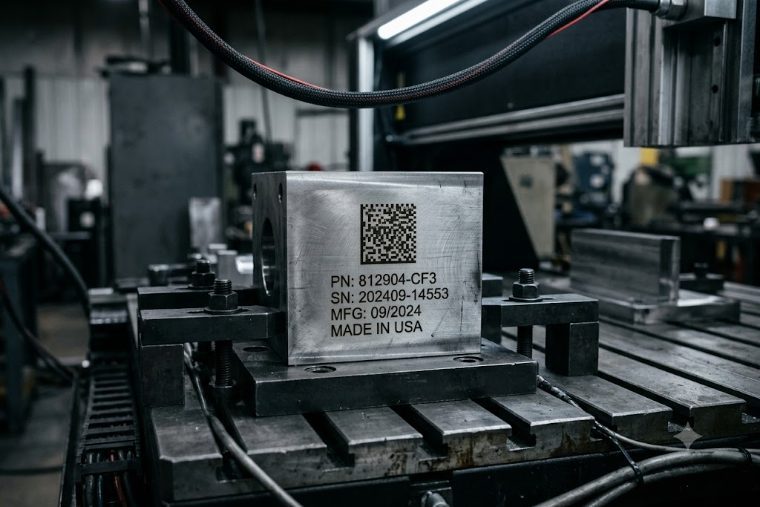
Regulated manufacturing
Buyer / specifier
Micro-machining vs. shop laser
Capability & safety claims
Two different industries share one name. Cutting a cardiac stent means removing a lace pattern from tubing a few millimetres across, with struts measured in tens of microns, on a rotary micro-machining system. Cutting an instrument tray means profiling sheet stock on a flat bed. Both are “laser cutting.” Only one of them is a machine you would find in a general fabrication shop. The accessible medical work is real and substantial — instrument marking, trays, enclosures, gaskets, fixtures — but it is not the work the brochures illustrate.
1 · Where the line falls.
The source material for this page lists valve frames, flexible shafts, vascular clips, cardiac stents, bone reamers and precision tubing as applications of laser cutting. Every one of those is accurate as a statement about the industry. None of them is achievable on a flat-bed sheet cutter, and the source never says so.
| Micro-machining | Flat-bed shop laser | |
|---|---|---|
| Stock | Small-diameter tubing, foil, thin ribbon | Sheet and plate |
| Motion | Rotary axis synchronised to the beam | X–Y gantry over a flat bed |
| Feature size | Struts and slots in the tens of microns | Features you can see and measure with calipers |
| Beam | Tightly focused, often pulsed to limit heat input | Continuous or modulated, larger spot |
| After the cut | Deburring, passivation, electropolishing as standard | Often finished as cut, or lightly deburred |
| Typical output | Stents, clips, valve frames, catheter components | Trays, enclosures, panels, gaskets, fixtures |
The cluster hub carries the figure showing this difference geometrically: flat sheet vs. tube micro-machining →
2 · What the laser genuinely contributes here.
Set aside the capability question and the advantages are straightforward, and they are the reason the technology took hold in this sector at all:
- No tool contact. Nothing presses on the part, so thin and delicate geometry does not deform, and there is no tool to shed material into a component destined for the body.
- No tool wear. The thousandth part is cut by the same beam as the first. For a regulated process, consistency across a lot is worth more than raw speed.
- No cutting fluid. One fewer contamination pathway, and one fewer cleaning validation to write.
- Permanent marking in the same technology. Identification that survives autoclaving and handling, applied without ink, adhesive or a second supplier.
- No tooling to commission. A design revision is a file change. In a sector where design changes trigger documentation, not having to re-cut a die is a real schedule advantage.
3 · The standards that actually govern the work.
These come up constantly in medical manufacturing discussions, so it is worth being precise about what each one is for. None of them is a property of a machine. Check against current editions before relying on any of this commercially.
| Standard | Covers |
|---|---|
| ISO 13485 | Quality management systems specific to medical devices — the central one. Built on ISO 9001 but with far heavier traceability and record-keeping obligations. |
| ISO 14971 | Risk management across the device lifecycle: identify hazards, assess, control, monitor. |
| ISO 10993 | Biocompatibility — whether materials in patient contact provoke an adverse biological response. |
| IEC 62304 | Medical device software lifecycle, where software is part of or is the device. |
| ISO 9001 | General quality management. A foundation, not a substitute for 13485. |
| ISO 45001 | Occupational health and safety management. |
Two things published lists get wrong here
OHSAS 18001 is withdrawn. It was superseded by ISO 45001 and is no longer a certifiable standard, yet it still appears in current articles. If a supplier cites it, that document is out of date.
A laser does not deliver compliance. Sources routinely claim laser cutting “enables” or “supports” ISO 13485 or ISO 14971. It does not. A quality system delivers compliance; a machine is one controlled process inside it, and it still has to be validated, documented and monitored like any other. Precision is a necessary condition, not a sufficient one.
4 · What a shop laser can honestly do in medical work.
This is the part the source omits entirely, and it is the part a real buyer needs.
| Job | Machine class | Realistic? |
|---|---|---|
| UDI, serial and lot marking on stainless instruments | Fiber marker (galvo) | Yes — the strongest fit in the sector |
| Instrument trays, sterilisation organisers, inserts | Fiber or CO2 flat bed | Yes |
| Device enclosures, panels, brackets, mounts | Fiber flat bed | Yes |
| Gaskets, seals, membranes, backing pads | CO2 flat bed | Yes — material dependent |
| Assembly jigs, fixtures, tooling, workholding | Either | Yes — and widely underrated |
| Cleanroom signage, labelling, equipment identification | Either | Yes |
| Cardiac and vascular stents | Tube micro-machining system | No — different machine class |
| Catheter tubing, flexible shafts, valve frames | Tube micro-machining system | No |
| Implantable components in patient contact | Specialist, validated production | No — regulatory before technical |
The application worth building a business on
Instrument marking. Every reusable surgical instrument needs permanent identification that survives repeated autoclaving, and a fiber marker does it by annealing — heating stainless steel just enough to grow a dark oxide layer without cutting into the surface. Because no material is removed, the corrosion resistance of the passive layer is preserved, which is exactly why abrasive or engraved marks are discouraged on instruments. Check against your customer’s own marking specification before quoting. Annealing, etching and marking compared →
5 · Precision and cost, answered straight.
Is laser cutting more precise than machining?
Not necessarily — and the source is right to say so. Machining holds equal or tighter tolerances on many features, leaves no heat-affected zone, and handles thick sections and true 3D geometry that a laser cannot. The laser wins on thin material, intricate 2D profiles, no tool wear, no fluid, and instant changeover. They are complementary; treating one as strictly better than the other is how parts end up on the wrong machine.
The honest caveat for medical work: a laser-cut edge carries a heat-affected zone and a recast layer. On a part going into the body, that is not cosmetic — it is why passivation and electropolishing are routine rather than optional.
Does it cost more?
The source answers this twice and contradicts itself — calling laser machines “more cost-effective due to their use of inexpensive components” in one section, then stating plainly that laser manufacturing costs more in another. The resolvable version:
- Higher capital cost than most conventional equipment of comparable capability.
- Ongoing consumables — optics, assist gas, filtration, service.
- But no tooling cost per design, which inverts the comparison for short runs, prototypes and frequent revisions — a common pattern in device development.
So: more expensive per machine, frequently cheaper per part at low and mixed volume. Neither claim is true on its own.
6 · A safety claim worth correcting.
“Enclosed within a protective glass tube” is not what makes a laser safe
The source states that laser cutting is inherently safe “thanks to the laser being enclosed within a protective glass tube.” The glass tube it is describing is the CO2 resonator — the component that generates the beam. It has nothing to do with operator protection, and fiber lasers have no such tube at all.
What actually protects an operator is the enclosure, the interlocks, the viewing window rated for the wavelength, and the extraction system — plus the discipline not to defeat any of them. An open or interlock-defeated machine is hazardous regardless of what the resonator is made of.
Related and frequently confused: a Class 1 rating describes the system as delivered, not the beam inside it. Safety in the materials cluster →
7 · FAQs
Frequently asked
Laser Cutting for Medical DevicesQAre stents made on a normal laser cutter?
No. Stents and catheter components are cut from small-diameter tubing on rotary micro-machining systems, with features in the tens of microns. A flat-bed shop laser cuts sheet and is a different class of machine.
QWhat medical work can a shop laser actually do?
UDI and serial marking on instruments, trays and sterilisation organisers, enclosures and panels, gaskets, and assembly fixtures. Real medical manufacturing work — just not stent cutting.
QWhich standards matter?
ISO 13485 (medical QMS), ISO 14971 (risk), ISO 10993 (biocompatibility), IEC 62304 (software). ISO 45001 replaced the withdrawn OHSAS 18001. None of them is a property of a machine.
QIs a laser more precise than machining?
Not necessarily. Machining matches or beats it on many features and leaves no heat-affected zone. The laser wins on thin, intricate 2D work with no tooling. Laser-cut medical parts usually still need passivation or electropolishing.
8 · Related in this series.
Part of Applications & Industries:
- Industrial applications — the other seven sectors, read as requirements
- Etching, marking and annealing — the mechanism behind instrument marking
- Fiber & metal cutting — what fiber does to stainless and titanium
- Pulsed lasers — why micro-machining pulses rather than running continuous
Keep exploring
One idea leads to the next.
Seeing how others use these machines is the fastest way to scope your own work. Follow the rest of the series, or talk it through with someone who runs these systems.