
CO2 · FM · UV
Shallow — top layer only
Operator
Deep engraving
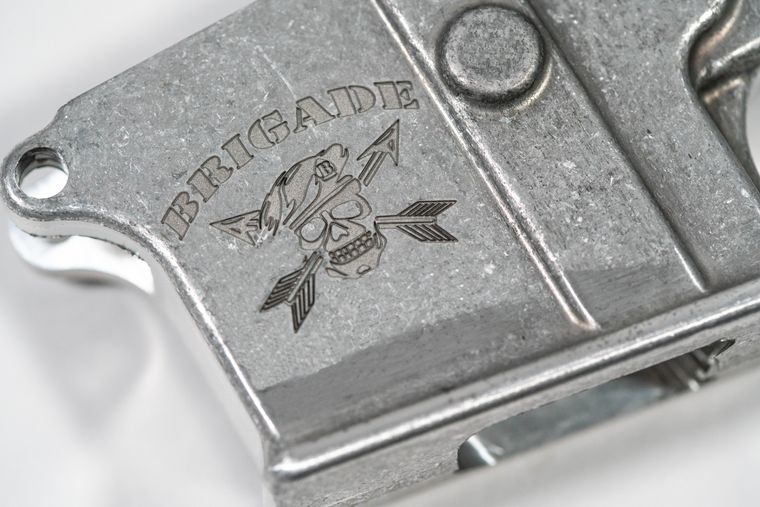
Laser etching heats a very thin surface layer until it melts and changes, rather than excavating material. Because the affected layer typically expands slightly, an etched mark is often marginally raised rather than sunk — which is the clearest physical tell against engraving. It sits between marking (colour change, essentially no material removed) and engraving (a recess you can feel). The trade is straightforward: etching is faster and gentler; engraving is deeper and more abrasion-resistant.
1 · The three-way distinction, settled.
| Process | What happens | Depth | Feel |
|---|---|---|---|
| Marking | Surface chemistry or colour changes — oxidation, annealing, colour shift | Essentially none | Smooth |
| Etching | A thin top layer melts and alters; often expands slightly | Very shallow | Marginally raised |
| Engraving | Material is removed to form a recess | Deeper — controllable | A recess you can feel |
These get used interchangeably in everyday shop talk, and mostly that’s harmless. It stops being harmless when a specification says “etched” and a customer expects a depth they can feel, or when a durability requirement quietly assumes engraving.
2 · Why choose etching.
- Speed. Removing less material takes less time — a real production advantage at volume.
- Less heat into the part. Shallower processing means a smaller heat-affected zone, which matters on thin stock and heat-sensitive assemblies.
- High contrast without depth. Serial numbers, codes and logos read clearly without compromising the surface.
- Works on thin coatings and plated stock where engraving would cut straight through the layer you’re marking.
- Dimensional integrity. You’re not removing meaningful material, so the part stays the size it was.
3 · Where engraving wins instead.
Depth buys durability. If a mark has to survive sustained abrasion, tumbling, heavy handling, or long outdoor exposure, a deeper engraved mark outlasts a shallow etched one. Etching is genuinely permanent — the surface is altered, not coated — but permanent and abrasion-proof aren’t the same claim.
Engraving also wins where the recess is functional: tactile markings, paint-fill, or anywhere the depth itself does a job.
4 · Materials and machines.
| Surface | Machine | Notes |
|---|---|---|
| Bare metals — stainless, aluminium, steel | FM Series fiber | Bare metal absorbs ~1 µm; this is the standard industrial case |
| Anodized / coated / painted metal | CO2 — LS · EVO | The coating absorbs the beam — how that works → |
| Ceramics, stone, glass | CO2, or UV for fine work | Surface-only by nature |
| Plastics | CO2 or UV | Varies enormously by polymer — test first |
| Heat-sensitive or very fine work | UV Series | Short wavelength, minimal heat spread |
5 · Typical applications.
Traceability and identification dominate: serial numbers, part numbers, 2D codes and barcodes for manufacturing traceability; medical device and instrument marking, where the mark must survive cleaning and sterilisation without harbouring contamination; tool and asset identification; and branding on finished goods where a visible recess would be unwelcome.
The common thread is that etching is chosen where the mark must be permanent and legible but not intrusive — you want it to survive, not to be felt.
A note on codes
If you’re etching 2D codes for machine reading, contrast and consistency matter more than depth. A scanner reads light and dark, not topography. That’s often the argument for etching over engraving in traceability work — it’s faster, and the reader can’t tell the difference.
6 · FAQs
Frequently asked
Laser EtchingQWhat is laser etching?
A surface process that melts and alters a very thin top layer rather than removing a recess. The layer often expands slightly, so the mark can be marginally raised. It sits between marking and engraving.
QEtching vs engraving?
Depth and mechanism. Etching melts a thin surface layer and is fast; engraving removes material for a recess you can feel and is more abrasion-resistant.
QWhat can be etched?
Most metals, coated and anodized surfaces, ceramics and many plastics. Bare metal is a fiber job; coated and non-metal surfaces are usually CO2.
QIs it permanent?
Yes for most purposes — the surface itself is altered, so it can’t rub off or peel. Being shallow, it can wear under sustained heavy abrasion where deep engraving would survive.
7 · Related in this series.
Part of Processes & Techniques:
- Cutting vs. engraving — the wider distinction
- Laser ablation — the mechanism beneath marking
- Anodized aluminum — what the beam actually does to the dye
Keep exploring
One idea leads to the next.
The right process is usually a bigger win than the right settings. Follow the rest of the series, or talk it through with someone who runs these systems.