
CO2 marking — LS · EVO
Dye bleaching in the coating
Operator
Cutting metal
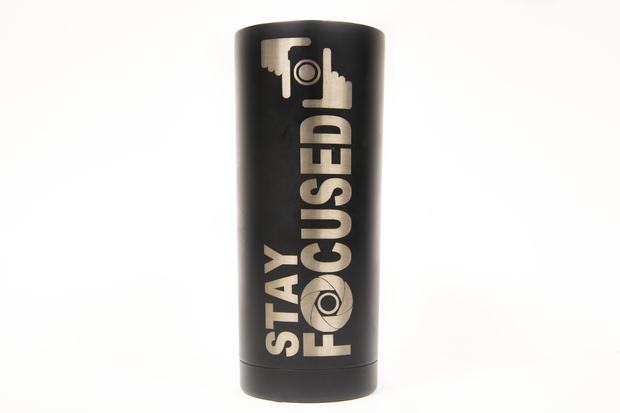
A CO2 laser marks anodized aluminum superbly, and the reason is that it isn’t marking the metal at all. Anodizing is an oxide coating, usually dyed; that coating absorbs 10.6 µm even though the aluminium underneath reflects it. The beam destroys the dye held inside that coating and leaves the coating itself in place — so the mark is a white, frosted anodic surface, not exposed bare metal, and the part keeps the corrosion protection the anodizing is there to provide. Black anodized stock gives the strongest contrast. It is marking only: you are not cutting metal, and the same machine does essentially nothing useful to bare aluminium, which needs a fiber laser.
1 · What’s actually happening.
Anodizing grows a hard oxide layer on the aluminium surface, and that layer is porous enough to take dye — which is how coloured anodized parts are made. Two useful consequences follow for laser work:
- The coating absorbs far-infrared, unlike the metal underneath. So there’s something for the beam to act on.
- The colour lives in the coating, held in its pores. Take the colour out and you have created contrast without adding anything — and without removing the coating.
So this is not ablation of the coating, and it is not engraving into the substrate — it is selective destruction of the dye within a coating that stays put. Push the power far enough and a CO2 beam can burn through the anodizing to the metal, but that is a defect, not the process: it takes the corrosion protection with it. (Mechanism per Larry Chesterfield in Products Finishing, the anodizing trade journal: “no anodic coating is actually removed.”) How ablation works, for the cases where it does apply →
The general principle worth taking away
A CO2 laser can mark many metals if something on the surface absorbs the beam — anodizing, paint, powder coat, or a purpose-made marking compound. In every case you’re working the coating, not the metal. It’s a genuinely useful capability, and it’s also why “my CO2 marks metal” and “my CO2 cuts metal” are completely different claims.
2 · What to expect from the result.
| Aspect | What you get |
|---|---|
| Mark colour | The bleached anodic surface — a frosted white, not exposed bare aluminium |
| Contrast | Set by colour saturation: highest on black anodizing, good on dark colours, weak on light or clear |
| Permanence | The dye is destroyed, not printed over — it can’t rub off, peel or fade like ink |
| Coating | Intact. Corrosion protection survives the mark. Field check: a continuity meter on the mark should read no continuity |
| Feel | Essentially flush — no coating is removed and no recess is cut |
| Speed | Fast, since only the dye in a thin surface layer has to go |
Typical uses follow directly from “permanent, high contrast, flush”: control panels, name and serial plates, asset tags, equipment identification, instrument fascias, and branded anodized products.
3 · Practical notes.
- Anodizing varies. Thickness, dye and sealing all differ between suppliers and finishes, so a setting proven on one batch may not carry to the next. Test when the stock changes.
- Less power than you’d guess. You are only taking colour out of a thin coating. Too much power burns through the anodizing to the metal, which muddies the mark and removes the corrosion protection — the thing you were trying to keep.
- Clear or light anodizing gives poor contrast — there is little colour to take out, so the bleached area barely differs from the surrounding finish. On clear anodizing the result depends on the alloy, the temper and the coating thickness. Dark stock is the right choice when contrast matters.
- It’s marking, full stop. No amount of power turns this into cutting aluminium on a CO2 machine.
Boss’s own CO2 settings reference is the right starting point rather than a generic number — CO2 settings by material →
4 · When you need the other machine.
| Job | Machine | Why |
|---|---|---|
| Mark anodized or coated aluminium | CO2 — LS · EVO | The coating absorbs the beam |
| Mark bare aluminium or steel | FM Series fiber marker | ~1 µm is absorbed by bare metal |
| Cut aluminium sheet | FC Series fiber cutter | Cutting metal is a fiber job at power |
| Fine, low-heat marks on sensitive parts | UV Series | Short wavelength, minimal heat |
5 · FAQs
Frequently asked
Anodized AluminumQCan a CO2 laser mark anodized aluminum?
Yes — one of the best metallic results a CO2 laser gives. It bleaches the colour out of the dyed anodized layer without removing the coating, so the mark comes up as a white frost on the anodized colour — crisp, permanent, and with the part’s corrosion protection intact.
QWhy anodized but not bare aluminum?
Because it’s marking the coating, not the metal. The oxide layer absorbs 10.6 µm; bare aluminium reflects it. Bare metal marking needs a fiber laser at about 1 µm.
QWhat colour is the mark?
A frosted white — the anodic surface with its colour bleached out — against the remaining anodized colour. It is not exposed bare aluminium: the coating stays put. Black anodizing gives the highest contrast.
QIs it permanent?
Yes. The dye is destroyed inside the coating rather than printed on top of it, so there is nothing to rub, peel or fade — and because the coating itself is not removed, the corrosion protection stays with the part.
6 · Related in this series.
Part of Materials & Safety:
- Laser ablation — the mechanism behind this
- Fiber vs. CO2 — why bare metal is different
- Glass — the other surface-only CO2 job
Keep exploring
One idea leads to the next.
Knowing how a material behaves under the beam is most of the job. Follow the rest of the series, or talk it through with someone who runs these systems.