
A thickness-by-power chart for fiber cutting steel, stainless, and aluminum — and why thin-sheet wattages don’t scale to plate.
Short answer
How thick a laser cuts metal depends almost entirely on fiber power. As a guide, ~1 kW cuts roughly 10 mm carbon steel, 5 mm stainless, and 3 mm aluminum; ~3 kW reaches about 22 mm steel / 12 mm stainless; and ~6 kW handles around 25 mm steel and 20–25 mm stainless, with the highest-power systems cutting thicker still. Thickness scales sub-linearly — doubling power adds capacity but not double the thickness — and aluminum and copper cut thinner than steel at the same power because they reflect and conduct heat. A high-power CO2 laser cuts only thin sheet (up to ~18-gauge), so plate is strictly a fiber job.
Thickness by fiber power.
| Fiber power | Carbon steel | Stainless | Aluminum |
|---|---|---|---|
| ~1 kW | ~10 mm | ~5 mm | ~3 mm |
| ~3 kW | ~22 mm | ~12 mm | ~10–12 mm |
| ~6 kW | ~25 mm | ~20–25 mm | ~16 mm |
| 12 kW+ | Thicker plate and higher speeds; the largest systems cut well beyond the figures above. | ||
Approximate maximums for clean production cutting; exact capacity varies by machine, optics, and assist gas.
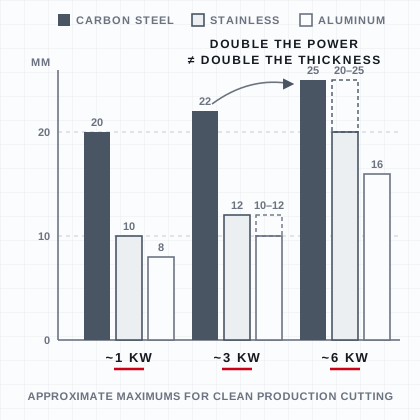
Why power and thickness don’t scale evenly.
More power always cuts thicker, but not proportionally — thickness scales sub-linearly, so going from 3 kW to 6 kW adds roughly 50% more usable thickness, not double. Material matters too: aluminum and copper reflect the beam and conduct heat away, so they cut thinner than carbon steel at the same power, while stainless sits in between.
Thin sheet vs. plate, and CO2’s limit.
For thin sheet, even an entry kilowatt fiber is plenty, and a high-power CO2 laser (Boss HP, 155–250 W) can cut up to about 18-gauge stainless — useful for signage and light fabrication. For plate, there is no CO2 substitute: thickness in the chart above is a fiber-cutter capability. Size the machine to the thickest metal you will cut regularly.
Related questions
How thick of metal can a laser cut?
It depends on fiber power: roughly 10 mm carbon steel and 5 mm stainless at 1 kW, up to ~25 mm steel and 20–25 mm stainless at 6 kW, with higher-power systems cutting thicker. Aluminum and copper cut thinner at a given power. A CO2 laser cuts only thin sheet.
How thick can a laser cutter cut steel?
A ~1 kW fiber laser cuts about 10 mm of carbon steel, ~3 kW reaches ~22 mm, and ~6 kW around 25 mm, with high-power systems going thicker. The figure is set by the fiber power, not the brand.
How many inches thick will a laser cut metal?
Common fiber cutters handle roughly ¾″–1″ (about 20–25 mm) of steel, and the highest-power industrial systems cut beyond 1″. Stainless and aluminum max out thinner than carbon steel at the same power.
How thick of metal can a 100-watt laser cut?
A 100 watt laser cannot cut metal — that is fiber-marker or CO2 territory, which only marks or cuts very thin sheet. Cutting measurable metal thickness requires a kilowatt-class fiber cutter, starting around 1 kW.
How do you cut 16-gauge steel — can a CO2 laser do it?
16-gauge steel (about 1.5 mm) is thin sheet. A high-power CO2 laser can cut light-gauge stainless (up to ~18-gauge), but 16-gauge and thicker mild steel is best and most reliably cut on a fiber laser, which handles it easily even at entry power.
Keep going
- Learn: Which Metals Cut Well — and How Thick
- Related: How many watts to cut metal? · Can you laser cut stainless steel? · Can a laser cutter cut metal?
- Products: FC Series fiber cutters