
Yes — stainless is one of the best metals to fiber-cut. Here’s how to get clean edges and what thickness each power handles.
Short answer
Yes — stainless steel is one of the best metals to laser cut, on a fiber laser. Fiber’s wavelength is absorbed well by stainless, and using nitrogen as the assist gas gives a clean, bright, oxide-free edge that often needs no finishing. Thickness depends on power: roughly 5 mm at 1 kW, ~12 mm at 3 kW, and up to ~20–25 mm at 6 kW. A high-power CO2 laser (like Boss’s HP, 150–250 W) can cut only thin stainless sheet (up to about 18-gauge); real thickness needs a fiber cutter such as Boss’s FC series. The heat-affected zone is small, so cutting doesn’t meaningfully harden the bulk material.
Fiber cuts stainless cleanly.
Stainless steel cuts beautifully on a fiber laser. The key to a clean result is the assist gas: nitrogen shields the cut so the edge comes out bright and oxide-free, ready to use without grinding, while oxygen cuts faster but leaves an oxidized edge. Boss’s FC Series fiber cutters handle stainless from thin sheet up through plate, depending on power.
Thickness by power, and why CO2 wattages fall short.
- ~1 kW fiber: up to about 5 mm stainless.
- ~3 kW fiber: up to about 12 mm.
- ~6 kW fiber: up to about 20–25 mm.
- High-power CO2 (150–250 W): thin sheet only — up to ~18-gauge.
This is why a “130 W” or “150 W” laser only cuts thin stainless: those are CO2 wattages. Cutting real stainless thickness is a kilowatt fiber job.
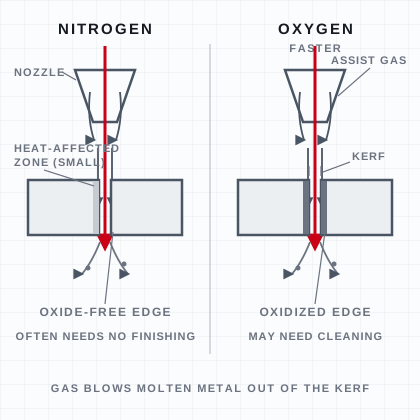
Does laser cutting harm the stainless?
Laser cutting puts very little heat into the part overall, so the heat-affected zone is small and it does not meaningfully harden the bulk material. With nitrogen assist the edge stays corrosion-resistant; with oxygen the edge oxidizes and may need cleaning before welding or finishing. For most stainless work, fiber cutting gives a clean, ready-to-use edge.
Related questions
Can you laser cut stainless steel?
Yes — stainless is one of the best metals to fiber-cut. With nitrogen assist you get a clean, bright, oxide-free edge that often needs no finishing. Thickness depends on power, from about 5 mm at 1 kW to 20–25 mm at 6 kW.
Can a laser cutter cut stainless steel / can stainless steel be laser cut?
Yes, on a fiber laser cutter. Stainless absorbs the fiber wavelength well and cuts cleanly with an assist gas. A high-power CO2 laser manages only thin stainless sheet, so for plate you need a fiber machine.
How do you laser cut stainless steel?
Use a fiber cutter with nitrogen assist for clean, oxide-free edges (or oxygen for faster, oxidized cuts), set focus and gas pressure for the thickness, and pierce before cutting. Match power to thickness, and run a test on the same grade and gauge first.
Does laser cutting harden stainless steel?
Not meaningfully. The heat-affected zone is small, so the bulk material’s properties are largely unchanged. With nitrogen assist the cut edge stays corrosion-resistant; an oxygen-cut edge oxidizes and may need cleaning before welding or finishing.
How to cut stainless steel with a 130 or 150 watt laser?
Those are CO2 wattages, and at 130–150 W a CO2 laser cuts only thin stainless sheet (roughly 18-gauge and under). For anything thicker, you need a kilowatt-class fiber cutter — watts in that range will not cut stainless plate.
Keep going
- Learn: Which Metals Cut Well — and How Thick
- Related: How thick of metal can a laser cut? · Can a laser cutter cut metal? · How do you laser engrave metal?
- Products: FC Series fiber cutters