
Why the wattage that cuts metal is measured in kilowatts, not the tens of watts hobby lasers advertise.
Short answer
To cut metal you need a kilowatt-class fiber laser — cutting starts around 1–2 kW (1,000–2,000 W) and goes up from there, not the 20–100 watts people often ask about. Those low wattages belong to fiber markers, which etch metal but do not cut it. As a rule, more power cuts thicker metal and faster: roughly 1 kW handles thin sheet, while 3–6 kW cuts plate. A high-power CO2 laser (155–250 W) is the only non-fiber exception, and it cuts only thin sheet. If your laser is rated in tens of watts, it marks metal — it does not cut it.
Cutting metal is a kilowatt job.
The single biggest misconception in metal lasers is wattage. Cutting metal needs a fiber laser measured in kilowatts: practical cutting starts around 1–2 kW and scales up. Boss’s FC Series fiber cutters run from about 1.5–2 kW on entry machines to 6 kW and well beyond for thick plate and high throughput. More power means thicker metal and faster cuts — though thickness scales sub-linearly, so doubling power adds capacity but not double the thickness.
Why 20W, 40W, and 100W lasers can’t cut metal.
A 20 W, 40 W, or even 100 W laser is a marker or engraver, not a cutter. Boss’s FM Series fiber markers (20–100 W) permanently mark, etch, and deep-engrave metal, but they cannot cut through it — there simply isn’t enough power density to blow a kerf through steel. The one non-fiber exception is a high-power CO2 laser (Boss HP, 155–250 W), which cuts thin sheet only.
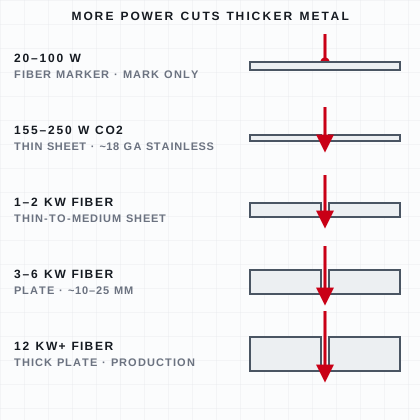
Rough power-to-capability guide.
- 20–100 W (fiber marker): marks and engraves metal — no cutting.
- 155–250 W (high-power CO2): cuts thin sheet (up to ~18ga stainless).
- 1–2 kW (fiber): cuts thin-to-medium sheet metal.
- 3–6 kW (fiber): cuts plate — ~10–25 mm depending on metal.
- 12 kW+ (fiber): thick plate and high-speed production.
Related questions
How many watts do you need to laser cut metal?
Cutting metal needs a kilowatt-class fiber laser — practically 1–2 kW to start and 3–6 kW for plate. The 20–100 watt figures people see are fiber markers, which only etch metal. Wattage in the tens of watts marks; wattage in the thousands cuts.
Can a 40 watt laser cut metal?
No. A 40 W laser — whether diode or CO2 — cannot cut metal; at most it marks coated or anodized surfaces. Cutting metal needs a kilowatt-class fiber laser, roughly 25–50 times that power.
Can a 20W laser cut metal? Can a 10W laser cut metal?
No. 10 W and 20 W lasers are for marking and engraving, and on bare metal they often need a marking spray even to leave a mark. They cannot cut metal — that requires a fiber cutter measured in kilowatts.
Can a 100 watt laser cutter cut thin metal?
A 100 W fiber marker cannot cut metal — it only marks. A 100 W+ CO2 laser still won’t cut metal until you reach Boss HP-series power (155–250 W), which cuts only thin sheet. For anything beyond thin sheet, you need a kilowatt fiber cutter.
How many watts to cut aluminum or steel?
Both need kilowatt fiber power. Roughly 1 kW cuts about 10 mm carbon steel or 3 mm aluminum; 3 kW reaches ~22 mm steel; 6 kW handles ~25 mm. Aluminum needs more power than steel for the same thickness because it reflects and conducts heat away.
What is the minimum laser wattage to cut metal?
For a true cut, the practical minimum is about 1 kW of fiber power for thin sheet. Below that, only a high-power CO2 laser (155 W+) cuts very thin sheet; tens of watts will not cut metal at all.
Keep going
- Learn: Which Metals Cut Well — and How Thick
- Related: Can a laser cutter cut metal? · How thick of metal can a laser cut? · What type of laser cuts metal?
- Products: FC Series fiber cutters