
The short answer is fiber — here’s why, and where CO2 and diode lasers do and don’t fit.
Short answer
The type of laser that cuts metal is a fiber laser. Its ~1064 nm wavelength is absorbed by metal far more efficiently than the CO2 wavelength — several times more — so fiber is the standard for cutting steel, stainless, aluminum, brass, and copper. A high-power CO2 laser can cut only thin sheet metal, and diode lasers cannot cut metal at all (they only mark coated surfaces). Cutting also requires real power: a kilowatt-class fiber source, not a tens-of-watts marker. So for metal cutting, the answer is a fiber cutter such as Boss’s FC series.
Fiber is the laser type for metal.
Metal reflects and poorly absorbs the CO2 wavelength but readily absorbs fiber’s ~1064 nm — a 1070 nm fiber beam has several times the cutting absorption of CO2 on metal. That efficiency, plus high power and an assist gas, is what lets fiber cut clean kerfs in steel, stainless, aluminum, brass, and copper. It is also why fiber has become the industry standard for sheet-metal fabrication. Boss’s FC Series fiber cutters cover this from entry kilowatt machines to high-power production systems.
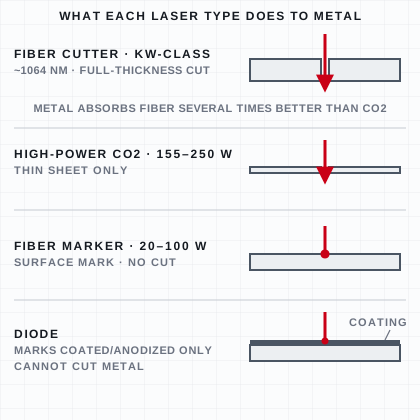
Where CO2 and diode fit.
- CO2 laser: excellent for non-metals; a high-power CO2 (Boss HP, 155–250 W) also cuts thin sheet metal, but not plate.
- Diode laser: marks coated or anodized metal at best — it cannot cut metal.
- Fiber marker (galvo): marks and engraves metal permanently, but does not cut.
So “which laser cuts metal” has one practical answer for real parts: a fiber cutter.
It’s about type and power together.
Being a fiber laser is necessary but not sufficient — you also need enough power. A 20–100 W fiber marker is fiber but only marks; a kilowatt-class fiber cutter is what cuts. Match the type (fiber) and the power (kilowatts) to the metal and thickness you need.
Related questions
What type of laser cuts metal?
A fiber laser. Its ~1064 nm wavelength is absorbed efficiently by metal, so a kilowatt-class fiber cutter cleanly cuts steel, stainless, aluminum, brass, and copper. CO2 cuts only thin sheet and diode lasers can’t cut metal at all.
What laser can cut metal / what kind of laser can cut metal?
A fiber laser cutter is what cuts metal. High-power CO2 can manage thin sheet, but for anything thicker — or for clean, fast production cutting — fiber is the laser type to use.
What laser cutter can cut metal?
A fiber laser cutter, such as Boss’s FC series. These use a kilowatt-class fiber source plus an assist gas to cut sheet metal and tube; the model and power are chosen by the metal type and thickness you cut.
What class of laser can cut metal?
By power class, metal cutting is a kilowatt-class fiber laser job — roughly 1 kW and up. By laser-safety class, industrial fiber cutters are high-powered Class 4 lasers, which is why they run in enclosed or interlocked systems for operator safety.
What is the minimum laser wattage to cut metal?
About 1 kW of fiber power for thin sheet is the practical floor; below that only a high-power CO2 (155 W+) cuts very thin sheet. Tens of watts — the range of fiber markers — will not cut metal.
Keep going
- Deep dive (coming soon): Best laser type for metal cutting
- Related: Can a laser cutter cut metal? · How many watts to cut metal? · How does a laser cutter work?
- Products: FC Series fiber cutters