
From gas tube to finished cut — how a CO2 laser makes its beam and turns it into a clean line.
Short answer
A CO2 laser works by running electricity through a sealed tube filled with CO2 gas, which excites the gas to emit a 10.6 µm infrared beam. That beam is steered by mirrors and focused by a lens to a fine point with enough energy to melt, burn, or vaporize the material, while air assist clears smoke and debris. A computer-controlled motion system moves the head along your design. Cutting drives the beam through the material; engraving uses less power to mark the surface. It works on non-metals because they absorb the CO2 wavelength — bare metal reflects it.
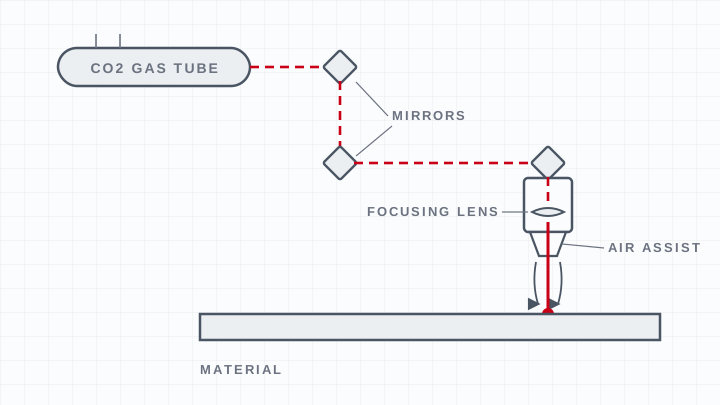
From gas tube to focused beam.
A CO2 laser’s beam starts in a sealed glass or metal tube of CO2 gas. An electrical discharge energizes the gas, which releases light at 10.6 µm. A series of mirrors bounces that beam to the cutting head, where a lens focuses it to a tiny, intense point. At that point the energy melts, burns, or vaporizes the material, and air assist blows away smoke and debris for a clean result.
Turning the beam into a part.
A computer-controlled motion system moves the head along the vector path from your design. Cutting uses enough power to go all the way through; engraving rasters at lower power to mark the surface. Because non-metals absorb the CO2 wavelength and bare metal reflects it, CO2 excels on wood, acrylic, leather, paper, and glass. For the general principle across laser types, see how does a laser cutter work?
Related questions
How does a CO2 laser cutter work?
It energizes a CO2 gas tube to produce a 10.6 µm beam, steers it with mirrors, and focuses it with a lens to a point that melts, burns, or vaporizes the material, while air assist clears the cut. A computer moves the head along your design. Cutting goes through the material; engraving marks the surface.
How does a CO2 laser engraver work?
The same way as a CO2 cutter, but at lower power and higher speed so the beam only marks the surface. The beam rasters back and forth to build an image or text line by line. The CO2 wavelength is absorbed by non-metals, giving clean, permanent engraving.
How do CO2 laser engraving and cutting machines work on acrylic?
Acrylic absorbs the 10.6 µm CO2 beam extremely well, so the laser cuts it with a glossy, flame-polished edge and engraves it to a frosted white (on cast acrylic). The beam melts/vaporizes a narrow line for cutting or a shallow layer for engraving, with air assist keeping it clean.
Keep going
- Learn: What Is a CO2 Laser?
- Related: How does a laser cutter work? · What is a CO2 laser? · What can a CO2 laser engrave?
- Products: LS / HP CO2 lasers