
From beam to finished cut — the parts of a laser cutter, what the assist gas does, and how cutting differs from engraving.
Short answer
A laser cutter works by focusing a high-intensity laser beam to a tiny point that melts, burns, or vaporizes the material along a path, while an assist gas blows the molten material and debris out of the cut to leave a clean edge. The beam comes from a laser source — a CO2 gas tube for non-metals, a fiber source for metals — and is steered by mirrors or fiber and focused by a lens, while the head moves under computer control to follow your design. Cutting drives the beam fully through the material; engraving uses less power to mark only the surface. Different materials need different laser types and settings.
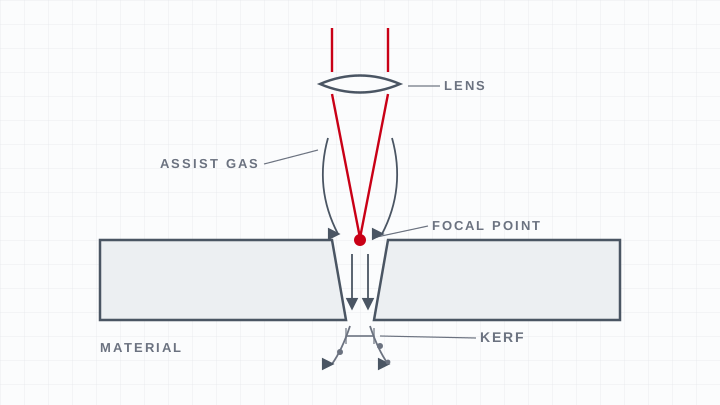
The beam: how a laser cutter makes its cut.
A laser cutter concentrates a beam of light through a focusing lens down to a fine point. At that point the energy is intense enough to instantly melt, burn, or vaporize the material. A stream of assist gas (compressed air, oxygen, or nitrogen) blows the molten material and smoke out of the cut — the kerf — keeping the edge clean and the flame controlled. A computer-controlled motion system moves the head (or the beam) along the vector path from your design.
CO2 vs. fiber: two ways to cut.
The laser source determines what a machine can cut. A CO2 laser (about 10.6 µm wavelength) is absorbed by non-metals, so it cuts and engraves wood, acrylic, leather, paper, and fabric. A fiber laser (about 1064 nm) is absorbed by metal, so it is the tool for cutting steel, stainless, aluminum, and brass. The mechanism is the same — focused heat plus assist gas — only the wavelength and source differ.
Cutting vs. engraving.
The difference is mostly power and intent. Cutting runs enough energy (often with a slower feed and stronger assist gas) to drive the beam all the way through the material so the part separates. Engraving uses lower power and faster motion so the beam only marks the surface. Many machines do both in one job — engrave first, then cut.
Related questions
How does a laser cutter work?
It focuses a laser beam to a fine point that melts, burns, or vaporizes the material, while assist gas blows the debris out of the cut. A computer-controlled motion system moves the beam along your design’s path. Cutting drives the beam through the material; engraving only marks the surface.
How does a CO2 laser cutter work?
A CO2 laser excites a gas-filled tube to produce a ~10.6 µm beam, which mirrors and a lens focus onto the material. That wavelength is absorbed by non-metals, so a CO2 laser cuts and engraves wood, acrylic, leather, glass, and similar materials. Assist air clears smoke and reduces charring.
How does a CNC laser cutter work?
“CNC” just means the machine is computer-controlled, which all modern lasers are. Software converts your design into a tool path, and the controller moves the laser head along it while firing the beam. The cutting itself works the same way — focused light plus assist gas.
How does a laser cutter work on wood?
On wood the focused beam burns and vaporizes a narrow line, and assist air clears smoke and limits charring at the edge. Denser woods and tight grain cut and engrave more evenly. Power and speed are set so the beam either marks the surface (engrave) or cuts all the way through.
How does a laser cutter work, step by step (simple version)?
You send a design to the machine; the controller moves the head along the path; a lens focuses the beam to a point that melts or vaporizes the material; assist gas clears the cut; and the beam passes through so the part separates. For engraving, the same process runs at lower power to mark only the surface.
Keep going
- Learn: How Laser Cutting Works
- Related: How does a CO2 laser cutter work? · What is a laser cutter? · What materials can a laser cutter cut?
- Products: LS / HP CO2 lasers · FC Series fiber cutters