
Not directly — but with a marking spray a CO2 laser leaves a permanent mark. Here’s how, and when you need fiber instead.
Short answer
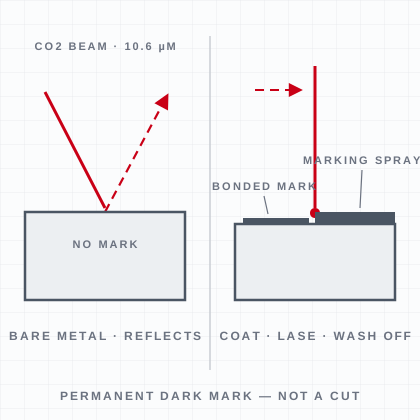
Not directly on bare metal — a CO2 laser’s 10.6 µm beam is reflected by bare metal, so it won’t mark steel, brass, or aluminum on its own. What it can do is mark metal with a marking spray or paste (CerMark, LaserBond, and similar): you coat the part, run the laser to bond the coating to the surface, then wash off the excess to leave a permanent dark mark. The one exception is anodized aluminum, which a CO2 laser marks directly by bleaching the colour out of the dyed anodic coating — the coating itself is not removed, so the mark reads as a white frost on the dark anodising. For fast, spray-free marking and true engraving on bare metal, a fiber laser is the right tool — see our metal-engraving guide.
Use a marking spray with a CO2 laser.
Because bare metal reflects the CO2 wavelength, the proven method is a metal marking spray or paste. You apply the coating, run the laser over it, and the heat bonds the coating to the metal; washing off the unfused excess leaves a durable, high-contrast dark mark. It is a real, production-used process for logos, serial numbers, and labels — it just adds a consumable and a couple of steps, and it bonds a mark to the surface rather than cutting into the metal.
When to use fiber instead.
If you mark metal regularly, a fiber laser is faster and needs no spray: it anneals, etches, and engraves bare stainless, aluminum, brass, copper, and titanium directly. Boss’s FM Series fiber markers are built for exactly this. The CO2-plus-spray route is best when you already own a CO2 laser and only mark metal occasionally; for volume metal marking, fiber wins. See how to laser engrave metal for the full picture.
Related questions
Can a CO2 laser engrave metal?
Not bare metal directly — the CO2 wavelength reflects off metal. With a marking spray or paste, a CO2 laser leaves a permanent dark mark, and it can mark anodized aluminum directly. For spray-free engraving of bare metal, use a fiber laser.
Can a CO2 laser engrave brass, aluminum, or stainless steel?
Only with a marking spray, which bonds a dark mark to the surface; bare brass, aluminum, and stainless reflect the CO2 beam and won’t mark on their own. Anodized aluminum is the exception and marks directly. A fiber laser marks all of these bare and is the better tool for metal.
How do you engrave metal with a CO2 laser?
Apply a metal marking spray or paste to the clean part, run the laser to fuse the coating to the surface, then wash off the excess to reveal a permanent dark mark. Test settings on scrap first. Without a coating, a CO2 laser cannot mark bare metal.
Will a CO2 laser engrave metal directly?
No — not bare metal. Direct CO2 marking only works on coated metal (via marking spray) or on anodized aluminum, where the laser bleaches the colour out of the anodic coating without removing it. Everything else needs a coating or a fiber laser.
Keep going
- Learn: Fiber vs. CO2 for Metal
- Related: How do you laser engrave metal? · Can a CO2 laser engrave anodized aluminum? · What can a CO2 laser engrave?
- Products: FM Series fiber markers · LS / HP CO2 lasers