
The short answer is yes — here’s which laser to use, what edges to expect, and how acrylic and plexiglass behave.
Short answer
Yes — acrylic is one of the best materials for a laser cutter, as long as it is a CO2 laser. The 10.6 µm beam is absorbed cleanly by acrylic (PMMA), leaving a glossy, flame-polished cut edge with no extra finishing. “Plexiglass” is just a brand of acrylic and cuts the same way. Use cast acrylic when you also want bright frosted engraving and extruded for clean transparent cuts at lower cost. Keep the protective mask on, run air assist and exhaust, and never confuse acrylic with polycarbonate (which burns) or PVC (which is toxic). For the full process, see our acrylic how-to guide.
Use a CO2 laser for glossy acrylic edges.
Acrylic and CO2 lasers are a near-perfect match. Because PMMA absorbs the 10.6 µm wavelength so well, a CO2 laser produces a flame-polished, glossy edge straight off the machine — something no mechanical saw or router can match. “Plexiglass,” “acrylic,” and “PMMA” are the same material, so they all cut the same way. Keep the protective masking on both faces during the cut to protect the surface from hot gas.
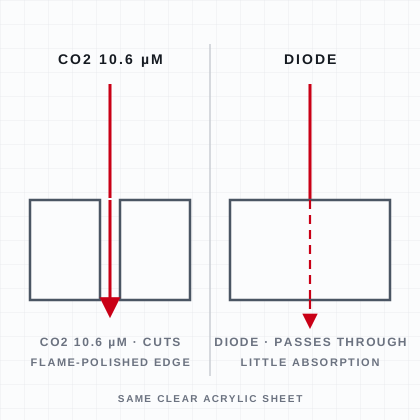
Cast vs. extruded, and why diodes struggle.
Cast acrylic engraves a bright frosty white and is the pick when a part is both cut and engraved; extruded acrylic cuts very cleanly, costs less, and is great for transparent parts (it melts at lower energy, so cut it with a bit less power). A blue diode laser is a poor fit for clear acrylic: the wavelength largely passes through it, so diodes mainly cut dark or opaque acrylic. For clear acrylic, use a CO2 laser.
Get the full step-by-step.
For settings by thickness and power, the gloss-vs-stress trade-off, masking choices, cleaning, and troubleshooting, see the complete guide: How to cut & engrave acrylic on a Boss CO2 laser. One safety rule that never changes — never cut PVC, vinyl, or polycarbonate, which are toxic or burn rather than cut.
Related questions
Can you cut acrylic with a laser cutter?
Yes — a CO2 laser cuts acrylic beautifully, leaving a glossy, flame-polished edge with no extra finishing. Keep the protective mask on, run air assist and exhaust, and start with low power and high speed, adjusting from there. It is one of the best materials a laser can cut.
Can a laser cutter cut plexiglass?
Yes. “Plexiglass” is a brand name for acrylic (PMMA), so it cuts exactly like any other acrylic on a CO2 laser. Expect the same clean, glossy edge.
How do you laser cut acrylic / cut an acrylic sheet with a laser?
Use a CO2 laser with the mask left on, air assist and exhaust running, focus set to the surface, and a test cut on scrap first. Engrave before cutting if the part needs both. Our acrylic how-to covers exact settings by thickness and power.
How to cut clear acrylic with a diode laser?
Clear acrylic is difficult for blue diode lasers because the wavelength mostly passes through it rather than being absorbed. Diodes cut dark or opaque acrylic better; for clear acrylic, a CO2 laser is the reliable tool.
How many watts do you need to cut acrylic?
A ~40 W CO2 laser cuts up to about ¼″ acrylic (slow the feed for clean edges), ~180 W is the commercial sweet spot, and 500–1000 W systems cut thick stock up to ~30 mm. More power buys speed and thickness, not better edge quality.
How do you clean laser-cut acrylic?
Use mild soap or detergent and lukewarm water. Avoid aggressive solvents and glass cleaners — they scratch and craze acrylic, and a laser-cut edge is already more stress-sensitive, so one harsh wipe-down can crack a finished part.
Keep going
- Full guide: How to cut & engrave acrylic on a Boss CO2 laser
- Learn: Acrylic
- Related: What materials can a laser cutter cut? · Can you laser engrave plastic?
- Products: LS / HP CO2 lasers