
Yes — if it’s a kilowatt-class fiber cutter, not a marker. Here’s the difference.
Short answer
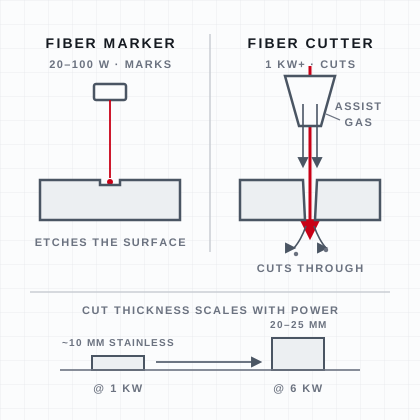
Yes — a fiber laser is the tool for cutting metal, but only a kilowatt-class fiber cutter, not a fiber marker. Cutting steel, stainless, aluminum, brass, and copper takes roughly 1 kW and up; the 20–100 watt fiber markers people ask about only mark metal — a 30 W or 50 W fiber will not cut even thin sheet reliably. Thickness scales with power (about 10 mm stainless at 1 kW up to 20–25 mm at 6 kW). Fiber also doesn’t cut non-metals — it passes through glass and acrylic and scorches wood. For machines and thickness, see our metal-cutting guides.
Marker vs. cutter: the key distinction.
“Fiber laser” covers two very different machines. A fiber marker (20–100 W, like Boss’s FM series) etches and engraves the metal surface but cannot cut through it. A fiber cutter (kilowatt-class, like Boss’s FC series) focuses far more power and uses an assist gas to cut clean parts from sheet and tube. So a fiber laser cuts metal — if it’s a cutter.
Power, thickness, and non-metals.
Cutting starts around 1–2 kW for thin-to-medium sheet and scales up — roughly 10 mm stainless at 1 kW to 20–25 mm at 6 kW. A 30 W or 50 W fiber is a marker and won’t reliably cut even 1 mm stainless. And fiber only cuts metal — it passes through glass and acrylic and scorches wood. For details, see can a laser cutter cut metal?, how many watts to cut metal?, and how thick can a laser cut?
Related questions
Can a fiber laser cut metal?
Yes, if it’s a kilowatt-class fiber cutter. Fiber is absorbed by metal, so a fiber cutter slices steel, stainless, aluminum, brass, and copper cleanly with an assist gas. A fiber marker (20–100 W) only marks — it doesn’t cut.
Can a 30W or 50W fiber laser cut metal?
No — those are marking wattages. A 30 W or 50 W fiber etches and engraves the metal surface but cannot cut through it; it won’t reliably cut even 1 mm stainless. Cutting needs a kilowatt-class fiber cutter.
Can a 50W fiber laser cut 0.8mm or 1mm stainless steel?
Not reliably. A 50 W fiber marker is built to mark, not cut, so even thin 0.8–1 mm stainless is beyond it for clean, repeatable cutting. For thin sheet you want at least a ~1 kW fiber cutter.
How do you cut 1-inch or thicker metal with a fiber laser?
Thick metal needs high power — roughly 6 kW handles around 20–25 mm (about 1 inch), and the largest industrial systems (12 kW and up) cut thicker. Pair the power with the right assist gas and settings for the metal. See our metal-cutting thickness guide.
Will a fiber laser cut non-metals?
No. Fiber is for metal — its wavelength passes through glass and clear acrylic and scorches wood, so it doesn’t cut non-metals. Use a CO2 laser for wood, acrylic, leather, and paper.
Keep going
- Related: Can a laser cutter cut metal? · How many watts to cut metal? · How thick can a laser cut?
- Products: FC Series fiber cutters