
Brittle materials — glass, ceramic, silicon
Thermal-stress / controlled-fracture
Concept
Metal cutting; glass engraving
Controlled-fracture cutting — also called thermal-stress cutting — separates brittle materials without really removing material. The beam heats a line on the surface; the heated zone wants to expand while the cool material around it resists, and that thermal stress drives a clean crack that propagates along the path. Because there’s almost no melting or vaporizing, the edge comes out exceptionally clean with a tiny heat-affected zone. It’s used on glass, ceramics, sapphire, and silicon wafers — and it is not how ductile metals are cut, because they deform instead of cracking.
1 · What controlled-fracture cutting is.
The other two cutting mechanisms remove material — vaporization boils it away, melt-and-blow melts and ejects it. Controlled fracture is different: it barely removes anything. The laser’s job is only to heat a precise line, and the material’s own thermal stress does the cutting by cracking along that line.
That’s why it’s reserved for brittle materials. Glass, ceramic, and silicon store thermal stress and release it as a clean, predictable crack. A ductile metal, by contrast, just bends and flows — it won’t hold a controlled fracture — which is why metals are cut by melt-and-blow instead.
2 · How the crack does the cutting.
The beam traces the cut line and heats a narrow band. The hot band tries to expand against the cooler surrounding material, building tensile stress. Guided along the path — and sometimes started from a tiny initiating notch — that stress drives a crack that follows the beam. The exact beam type, and whether a cooling step (a following air or water jet to sharpen the thermal gradient) is used, varies by material and system.
Why the edge is so clean
No molten pool means no dross, no re-solidified bulge, and a very small heat-affected zone. On the right brittle material, controlled fracture gives an edge that melting-based methods can’t match.
3 · What it’s really for.
| Material | Where it shows up |
|---|---|
| Display & flat glass | Separating panels and screens with a clean, strong edge |
| Ceramics & sapphire | Electronics substrates and hard, brittle components |
| Silicon wafers | Dicing wafers into individual chips in semiconductor manufacturing |
These are largely specialized industrial applications — precision electronics and display manufacturing — rather than everyday shop cutting.
4 · Correcting the record: it’s for brittle materials, not metal.
Controlled fracture does not cut aluminum, titanium, or steel
You’ll see this method described as a way to cut ductile metals like aluminum and titanium. That’s not right. Ductile metals deform and flow under heat rather than holding a clean crack, so they can’t be controlled-fractured — they’re cut by melt-and-blow. Controlled fracture is a brittle-material process. Getting this straight matters, because it decides which process — and which machine — a job actually needs.
5 · Where a Boss laser fits.
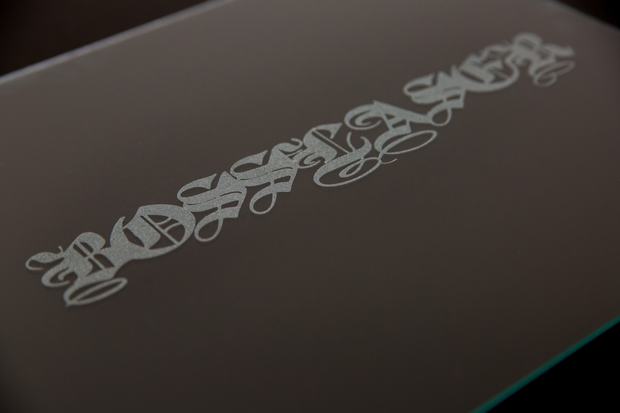
Most everyday brittle-material work on a shop laser isn’t full through-fracture cutting — it’s engraving and marking glass and ceramic, where a CO2 laser controllably heats the surface into a frosted mark. Boss LS and EVO CO2 machines engrave glass and ceramic; for the finest, high-contrast marks, the UV series is the tool. True industrial fracture-cutting of glass or silicon is a specialized process, out of scope for the standard lineup.
Working with glass or ceramic?
Most shop glass and ceramic work is engraving, not fracture-cutting — a CO2 laser job.
Frequently asked
Controlled fractureQWhat is controlled-fracture cutting?
A laser method for brittle materials: the beam heats a line to create thermal stress, and a controlled crack propagates along it to separate the material. With almost no melting or vaporizing, the edge is very clean with a minimal heat-affected zone. It’s used for glass, ceramics, sapphire, and silicon wafers.
QWhat materials is it for?
Brittle materials — glass, ceramics, sapphire, and silicon wafers — which crack cleanly under controlled thermal stress. It is not for ductile metals like aluminum or titanium, which are cut by melt-and-blow.
QCan it cut metal?
No. Ductile metals deform rather than crack cleanly, so they’re cut by melt-and-blow — the beam melts the metal and assist gas ejects it. Controlled fracture only works on brittle materials that propagate a clean crack.
QHow is it different from melting or vaporizing?
Those remove material by turning it to liquid or gas. Controlled fracture removes almost none — it heats a line so thermal stress cracks the part along it, which is why the edge is exceptionally clean.
Related in this series
Part of How Laser Cutting Works:
- Vaporization cutting — material boils straight to gas
- Oxidation & melt cutting — how metal actually gets cut
- Laser ablation — precise material removal, layer by layer
- Laser cutting & engraving glass — the material in practice
Keep exploring
One idea leads to the next.
Controlled fracture is one of several ways a laser separates material. Follow the rest of the series, or talk it through with someone who runs these systems.